

 0
0

Replatforming a monolith into microservices is not a refactoring exercise alone. It is a business continuity exercise.
The teams that do it well treat migration as a controlled product change, not a dramatic rewrite. That distinction matters. AWS and Microsoft architecture guidance consistently point to incremental decomposition, gateway-based routing, and traffic shifting because big-bang rebuilds carry a much higher failure rate: too much code changes at once, rollback becomes messy, and data drift starts quietly before anyone notices.
A safer path is to keep the monolith alive while you peel capabilities away one by one. Done right, users barely notice the transition.
WHAT'S IN THE ARTICLE
Why monolith to microservices replatforming fails without a phased plan
Many migrations stall in numerous problems, but mostly because the target architecture gets more attention than the migration path. Teams spend months designing future-state services, then hit real-world constraints: shared databases, hidden dependencies, brittle release processes, and workflows that only one senior developer fully understands.
The first hard truth is simple: if your current platform cannot support safe, frequent change, microservices will expose that weakness faster, not fix it.
A phased migration plan lowers that risk because it limits the blast radius of every move. It also creates short feedback loops. Instead of waiting a year to learn whether the architecture works, you learn after the first extracted service.
A practical migration plan usually needs these controls in place before any major extraction starts:
- Traffic control: API gateway, ingress, or reverse proxy that can route requests between old and new paths
- Release safety: feature flags, canary rollouts, blue-green deployment
- Observability: centralized logs, metrics, tracing
- Data migration discipline: backfills, dual writes, reconciliation checks
- Rollback design: instant route reversal without destructive schema changes

Looking to Build an MVP without worries about strategy planning?
EVNE Developers is a dedicated software development team with a product mindset.
We’ll be happy to help you turn your idea into life and successfully monetize it.
Primary steps to define the migration path
Step 1: Assess the monolith and define service boundaries
Start with the business, not the codebase.
The best service boundaries usually map to business capabilities with distinct workflows, rules, and ownership. Orders, billing, identity, catalog, claims, scheduling, or reporting are common examples. Domain-driven design helps here because it forces a clearer question: which parts of the system truly belong together, and which parts are only coupled because of history?
Code analysis still matters. You need dependency maps, change-frequency analysis, runtime traces, and database access patterns. A module that looks independent in the UI may still rely on shared tables, batch jobs, or internal utility classes buried deep in the monolith.
This is where many teams get their first useful surprise.
A good first extraction candidate usually has these traits:
- High business value: frequent change requests, scaling pressure, or clear user impact
- Moderate dependency profile: not isolated, but not tied to every major workflow
- Clear data ownership: identifiable tables, records, or aggregates
- Measurable success criteria: latency, deployment frequency, defect rate, conversion, or operational cost
Step 2: Add a gateway layer before splitting services
Before carving out functionality, create a stable front door.
An API gateway or facade lets clients keep calling one system while the routing behind the scenes changes over time. That is the foundation of the strangler pattern: the monolith remains active, new services appear beside it, and traffic gradually shifts feature by feature.
This layer is also the right place to keep security and governance consistent. Authentication, rate limiting, request validation, and API versioning should not fragment during migration. If the monolith already uses OAuth, JWTs, or another token model, the new services should integrate with the same trust model from day one.
Without a gateway, migrations often create accidental client churn. Mobile apps, partner integrations, and internal systems start learning new endpoints too early. Then every backend change becomes a client coordination problem.
Here is a simple way to think about the migration path:
| Migration phase | What users see | What the platform does | Exit criteria |
| Gateway introduction | No visible change | All traffic still routes to monolith | Central routing, auth, and logs are stable |
| First service shadowing | No visible change | New service receives mirrored or test traffic | Responses match expected behavior |
| Partial cutover | Small user slice on new path | Canary or feature-flag rollout | Error rates and latency stay within target |
| Full cutover | Same user experience | Gateway routes feature traffic to service | Rollback path remains available |
| Monolith retirement for feature | No change | Old code path disabled or removed | Data ownership fully transferred |
Step 3: Extract the first microservice with the strangler pattern
Pick one bounded capability and move only that slice.
Do not begin with the most politically visible domain. Do not begin with the hardest domain either. The first service should teach the organization how to migrate safely. That learning is worth more than architectural purity.
A solid first extraction often follows this order:
- Define the service contract.
- Build the new service behind the existing interface.
- Add monitoring and contract tests.
- Mirror or shadow traffic where possible.
- Cut over a small percentage of real traffic.
- Expand gradually.
- Keep instant rollback ready.
Contract compatibility matters more than clever implementation. If external consumers expect a certain response shape or timing behavior, preserve it unless there is a controlled versioning plan. Consumer-driven contract tests can catch breakage before production does.
One warning: avoid creating a distributed monolith on day one. If the new service cannot complete a simple request without chaining through multiple other services, you have moved code without reducing coupling.

Proving the Concept for FinTech Startup with a Smart Algorithm for Detecting Subscriptions
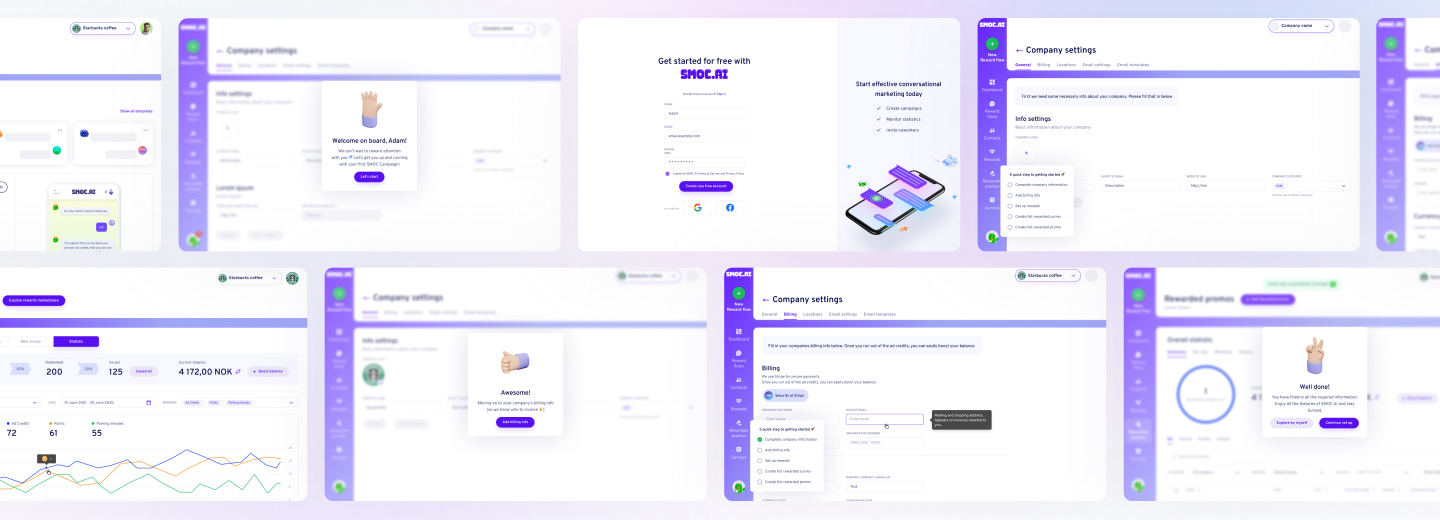
Scaling from Prototype into a User-Friendly and Conversational Marketing Platform
Practical part of execution of the migration process
Step 4: Migrate data safely with dual writes, backfills, and validation
Database separation is usually the hardest part of monolith decomposition.
A microservice should own its data store. Yet the monolith database often contains years of cross-cutting logic, shared tables, triggers, and reporting dependencies. If you split code without handling data ownership, the new architecture stays fragile.
The common low-risk pattern combines historical backfill with live synchronization. Historical records are copied from the monolith into the new service store, while ongoing writes are sent to both systems during transition. That gives the new service a chance to catch up without forcing downtime.
That approach only works if you treat write paths carefully:
- Backfill: copy existing records in batches from a replica or controlled export
- Dual writes: send new mutations to the new service during the transition window
- Idempotency: make repeated writes safe so retries do not create duplicates
- Reconciliation: compare counts, checksums, and sampled records before cutover
Validation belongs in the new service API, not only in the database. That protects the service from bad data entering through migration scripts, partner integrations, or retry jobs. It also prepares the service to live independently once the monolith stops feeding it.
For sensitive domains, security controls need equal attention. Encryption in transit, secrets management, access policies, audit logs, and role enforcement should remain consistent across old and new components. Migration is a bad time to create permission gaps.
Step 5: Design cross-service communication for latency and reliability
As soon as you have more than one service, network behavior becomes part of your application design.
Synchronous calls are fine for real-time needs, but they must be limited. If every user request triggers a chain of downstream HTTP calls, latency rises and failure modes multiply. That is why experienced teams reserve synchronous communication for cases that truly need immediate responses.
Event-driven flows often reduce that pressure. Orders can publish an event. Billing, notifications, analytics, or downstream processing can react asynchronously. This model is especially useful during migration because the monolith and new services can subscribe to the same event flow while responsibilities shift.
Two communication rules help most teams avoid trouble:
- Keep service APIs coarse enough to be useful: prefer a few meaningful calls over many tiny remote lookups
- Use resilience patterns at the edge of every dependency: timeouts, retries, circuit breakers, dead-letter queues, idempotency keys
Distributed transactions deserve special care. Traditional two-phase commit adds tight coupling and usually slows systems down. For multi-step business actions, saga patterns and compensating actions are typically a better fit. An order can be created, inventory reserved, payment attempted, and cancellation events issued if something fails later in the flow.
That model asks for stronger business design, but it scales better operationally.
Step 6: Build the deployment, testing, and rollback path before major cutover
A migration is only as safe as its rollback plan.
That is why release engineering cannot be an afterthought. CI/CD pipelines, environment parity, infrastructure as code, automated security scans, and runtime observability should be in place early. Teams that invest here usually move faster later because they are no longer debating each deployment manually.
Canary releases are especially useful during replatforming. Send a small share of traffic to the new service, compare latency and error rates, then ramp up only when the numbers stay healthy. If they do not, route traffic back immediately. No drama. No customer-wide outage.
The testing stack needs more than unit tests. During migration, the most valuable coverage often comes from integration, contract, and production-like flow testing.
A practical testing mix includes:
- Unit tests for service logic
- Contract tests between consumers and providers
- End-to-end tests for critical flows
- Load tests before cutover
- Production smoke tests during canary rollout
Observability should answer three questions fast: Is the new service working, is it returning correct data, and is it hurting the broader platform? Distributed tracing, structured logs, and service-level dashboards make that answer visible in minutes instead of hours.
Step 7: Organize team around service ownership, not handoffs
Microservices change operating models as much as technical architecture.
If one centralized team builds services while another deploys them and a third team handles incidents, handoff delays can erase most of the speed benefit. A better model is clear ownership by cross-functional teams responsible for delivery and runtime health of a defined capability.
This does not mean every team works alone. Shared platform standards still matter. Security baselines, CI/CD templates, observability rules, and cloud guardrails should stay centralized enough to prevent chaos. What changes is execution: teams own outcomes, not just tickets.
For product-focused organizations, migration metrics should go beyond infrastructure. Track whether the move improves release frequency, incident recovery time, feature lead time, scaling efficiency, and customer-facing reliability. If the architecture becomes cleaner but delivery slows down, the migration is missing the point.

Need Checking What Your Product Market is Able to Offer?
EVNE Developers is a dedicated software development team with a product mindset.
We’ll be happy to help you turn your idea into life and successfully monetize it.
Conclusion
After the first cutover, resist the urge to accelerate blindly.
Use the first extraction to refine your playbook. Which dependencies were hidden? Which test gaps showed up late? How much operational overhead did one more service introduce? The second and third extractions should be better because the platform, process, and team habits improved, not just because the architecture diagram got more detailed.
A disciplined migration rhythm usually looks like this:
- One well-scoped service at a time
- Shared patterns for data sync and cutover
- Reusable platform components for auth, telemetry, and deployment
- Regular reviews of whether each new service truly reduces coupling
That last point matters. Not every module deserves to become a microservice. Some parts of the monolith may be stable, low-risk, and cheaper to leave alone for now. Good replatforming is selective.
The strongest migrations are not the fastest ones on paper. They are the ones that keep revenue flowing, protect data integrity, and leave the business with a platform that is actually easier to change next quarter than it was this quarter.
Migrating to microservices can help your organization scale more efficiently, deploy updates faster, isolate failures, and adopt new technologies more easily. It also enables teams to work independently on different services.
Start with non-critical components, use automated testing, implement robust monitoring, and ensure you have a rollback plan. Incremental migration and thorough documentation are also essential.
Common challenges include data consistency, service communication, increased operational complexity, and cultural shifts within teams. Planning and adopting best practices can help mitigate these issues.
The timeline varies depending on the size and complexity of your application, team experience, and available resources. It can range from several months to over a year for large systems.

About author
Roman Bondarenko is the CEO of EVNE Developers. He is an expert in software development and technological entrepreneurship and has 10+years of experience in digital transformation consulting in Healthcare, FinTech, Supply Chain and Logistics.
Author | CEO EVNE Developers