

 0
0

High-volume fintech platforms do not fail because they lack features. They fail when transaction spikes expose tight coupling, long synchronous call chains, and weak recovery paths. A card authorization, ledger update, fraud check, customer notification, and settlement workflow may all depend on the same transaction, yet many platforms still push that work through blocking APIs and shared databases.
Event-driven architecture changes that operating model. Instead of asking one service to wait for another, the platform records what happened as an immutable event and lets interested services react asynchronously. IBM describes event-driven architecture as a model built around publishing, capturing, processing, and storing events. In fintech, that shift matters because speed and durability are business requirements, not engineering nice-to-haves. Research on real-time payment systems has shown event-driven designs reaching processing latencies below 200 milliseconds with 99.99% success rates, a strong result for platforms dealing with continuous transaction flow.
WHAT'S IN THE ARTICLE
- 01Why fintech is a natural fit for event-driven systems
- 02The building blocks that matter most
- 03A rollout plan that avoids a rewrite trap
- 04Design choices that separate strong systems from noisy ones
- 05Security and compliance need first-class treatment
- 06Common failure points in architecture building
- 07Conclusion
Why fintech is a natural fit for event-driven systems
A payment or trading platform produces a constant stream of facts: , , , , . Each fact can trigger several downstream actions at once. Fraud services need it. Reconciliation needs it. Customer messaging needs it. Analytics needs it. In a request/response setup, these dependencies create fragile chains that are hard to scale and even harder to change.
Event-driven architecture breaks that dependency chain. Producers publish events without caring which services consume them. Consumers subscribe only to the events they need. That loose coupling makes room for independent scaling, safer releases, and faster response to traffic bursts.
That matters when a few hundred extra milliseconds can mean abandoned checkouts, delayed payouts, or duplicate settlement actions.
There is also a compliance angle. Financial platforms need auditability. An append-only event log gives teams a verifiable record of state changes over time. When paired with event sourcing or CQRS where it fits, it can support both reliable write processing and fast read models for balances, dashboards, or case management.
The building blocks that matter most
At a practical level, most fintech event-driven stacks are built from the same core parts: event producers, a broker or streaming platform, partitioned topics, consumers, schema management, and observability. Producers emit domain events. Brokers store and route them. Consumers process them. Schema controls keep contract changes from breaking downstream services. Observability tells you when lag, retries, or failed processing start to rise.
Partitioning deserves more attention than it usually gets. In systems that must preserve ordering per customer, account, or payment, the partition key is not a small implementation detail. It decides how work is distributed and what “correct order” means. Pick the wrong key and one hot customer or merchant can overload a single partition while the rest of the cluster sits idle.
A quick selection guide helps when teams are choosing the backbone.
| Platform | Best fit in fintech | Strengths | Main trade-off |
| Kafka or managed Kafka | Payments, ledgers, market data, audit streams | High throughput, replay, partition-based scaling, durability | More operational design decisions |
| RabbitMQ | Workflow messaging, lower-volume service coordination | Flexible routing, familiar queue model | Lower throughput ceiling for very large streams |
| Cloud streams like Kinesis or Event Hubs | Teams already deep in one cloud stack | Managed operations, good cloud integration | Throughput limits and cost tuning per shard or unit |
| Event buses like EventBridge | SaaS and partner event integrations | Fast setup, managed routing, built-in integrations | Less control for low-latency core processing |
For core payment and ledger traffic, Kafka and managed Kafka services are often the front-runners because they combine replay, durability, and strong horizontal scaling. PayPal has publicly described Kafka usage at peak rates around 21 million messages per second during major retail periods. Coinbase reported cutting end-to-end streaming latency by about 95% after moving key workloads from Kinesis to Kafka, dropping from roughly 200 milliseconds to under 10 milliseconds for some paths.

Looking to Build an MVP without worries about strategy planning?
EVNE Developers is a dedicated software development team with a product mindset.
We’ll be happy to help you turn your idea into life and successfully monetize it.
A rollout plan that avoids a rewrite trap
The safest way to adopt event-driven architecture in fintech is rarely a full rebuild. Start by mapping domain events in the current system. Event storming workshops help, but the goal is simple: identify the business facts that matter and name them clearly. is a business event. is not.
Then connect the existing platform to the event layer without breaking production. The transactional outbox pattern is a strong starting point. When a service commits a business change, it writes the event to an outbox table in the same database transaction. A relay process publishes that event to the broker. If the legacy system is too rigid for code changes, change data capture can bridge the gap by reading committed database changes and publishing them to streams.
From there, keep the migration narrow and measurable.
- Step 1: Define a small event catalog for one business flow, with clear ownership for each event type.
- Step 2: Add an outbox or CDC pipeline so committed state changes become durable events.
- Step 3: Stand up the broker, schema registry, access controls, and baseline dashboards before sending critical traffic.
- Step 4: Build one or two consumers for a high-value use case, often fraud checks, customer notifications, or reconciliation.
- Step 5: Run the new path in parallel with the current path and compare outputs for parity.
- Step 6: Shift traffic gradually with feature flags, rollback rules, and clear cutover metrics.
A strong first use case has three traits: visible business value, manageable scope, and measurable pain in the current system. Real-time fraud scoring is a common candidate. So is payment status propagation, where customers and internal teams need accurate updates fast.
The metric that matters is not how many services were split out. It is whether the platform became faster, more resilient, and easier to change without raising risk.
Design choices that separate strong systems from noisy ones
Many fintech teams talk about event-driven architecture as if the broker were the hard part. It usually is not. The hard part is getting the operating rules right.
First, design for at-least-once delivery. Exactly-once processing across distributed services sounds ideal, but it is costly and easy to misunderstand. In most fintech workloads, a better answer is idempotency. Give each event a unique ID. Make consumers safe to reprocess the same event. Use deduplication checks, versioning rules, or conditional writes where needed. A duplicate event should not settle the payment twice.
Second, make replay a planned feature. Streams are valuable because teams can rebuild read models, backfill analytics, or recover state after incidents. That only works if events are stable, well-named, and retained for the right period. Replay is not free, though. If consumers are not idempotent, replay turns into a risk event.
Third, keep payloads disciplined. Large, unstable events slow everything down and make schema governance harder. Carry identifiers and business facts, not entire object graphs copied from internal APIs. Sensitive fields should be minimized, tokenized, or omitted.
Throughput gains usually come from discipline in keys, batching, and consumer design, not from adding more services.
After teams have the first flow working, a few engineering controls pay off quickly:
- Idempotent consumers
- Dead-letter topics
- Retry backoff
- Schema registry
- Lag-based autoscaling
Monzo’s public engineering work is a useful reminder here. Its teams built Kafka-based patterns for retries and dead-letter handling so one bad message would not stall a full stream. That kind of operational design turns a promising architecture into a reliable platform.

Proving the Concept for FinTech Startup with a Smart Algorithm for Detecting Subscriptions
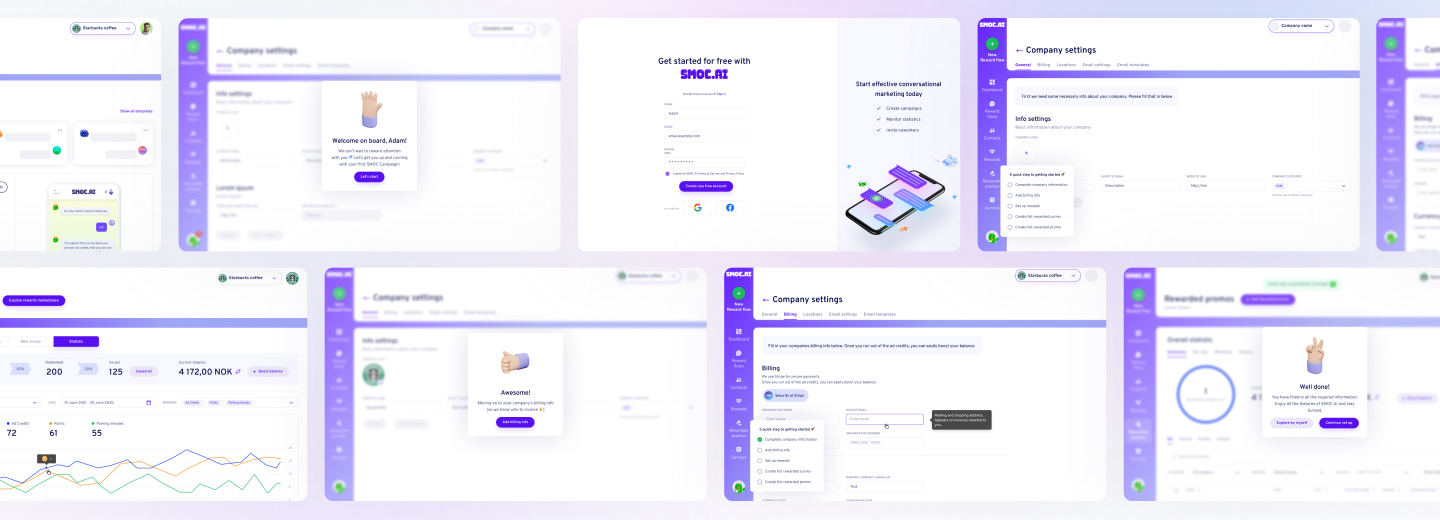
Scaling from Prototype into a User-Friendly and Conversational Marketing Platform
Security and compliance need first-class treatment
Financial events often carry payment data, account references, user identifiers, or regulated health and insurance data. That means the event layer must be treated as production-grade infrastructure from day one. Use TLS in transit, encryption at rest, strict topic ACLs, short-lived credentials, and service identity controls. Managed services can reduce setup time, but they do not remove the need for topic-level authorization and audit logging.
Data minimization matters just as much as encryption. If a fraud service only needs a tokenized card reference and transaction amount, do not publish the full payload. Immutable logs are useful for audits, but they can create privacy problems if teams dump raw personal data into every event. In regulated environments, schema review should be part of release governance, not a documentation task saved for later.
An event log is an asset only if access is controlled as tightly as the ledger itself.
Common failure points in architecture building
Most event-driven fintech problems are not caused by the message broker. They come from weak contracts, unclear ownership, or operational blind spots. Topic sprawl is a common example. Teams create too many overlapping event types, then no one knows which stream is authoritative. Another frequent issue is treating the broker as a dump pipe for internal state changes rather than a clean business event channel.
The warning signs are easy to spot after a few months.
- Hot partitions
- Fat payloads
- Missing correlation IDs
- No replay policy
- Unowned schemas
When these show up together, incident response slows down, consumer lag rises, and trust in the event layer drops.

Need Checking What Your Product Market is Able to Offer?
EVNE Developers is a dedicated software development team with a product mindset.
We’ll be happy to help you turn your idea into life and successfully monetize it.
Conclusion
A serious fintech implementation needs both platform metrics and business metrics. Platform health tells you whether the architecture is stable. Business metrics tell you whether it is solving the right problem. Watch p95 and p99 event latency, consumer lag, retry volume, dead-letter rates, under-replicated partitions, schema validation failures, and replay duration. Then tie those numbers to business outcomes: authorization time, failed transaction rate, settlement SLA, duplicate processing rate, and fraud decision speed.
Distributed tracing helps connect user actions to downstream events. Correlation IDs should be present in every event, every log line, and every trace span. When a payment is delayed, teams should be able to answer three questions fast: where it stopped, why it stopped, and whether replay or retry is safe.
Fintech teams usually get the best return by starting with one painful, high-volume flow, proving lower latency and better recovery, and only then expanding the event model across the rest of the platform. That sequence keeps the architecture tied to business value, which is where it needs to stay.
For teams that need speed and measurable product outcomes, EVNE Developers often favors a product-first approach: validate pricing and billing workflows early, launch a revenue-ready MVP, then iterate based on metrics rather than feature volume.
High-volume fintech platforms require rapid processing, real-time analytics, and seamless integration with multiple services. EDA allows these platforms to efficiently manage spikes in user activity, ensure data consistency, and provide a better user experience by decoupling services and enabling asynchronous communication.
Popular technologies include Apache Kafka, RabbitMQ, AWS EventBridge, and cloud-native solutions like Azure Event Grid. These tools help manage event streams, message queues, and real-time data processing.
Security best practices include encrypting data in transit and at rest, implementing strict access controls, monitoring event flows for anomalies, and complying with industry regulations such as PCI DSS and GDPR.
Yes, legacy systems can be incrementally migrated by introducing event-driven components alongside existing infrastructure. This hybrid approach allows gradual modernization without disrupting core business operations.

About author
Roman Bondarenko is the CEO of EVNE Developers. He is an expert in software development and technological entrepreneurship and has 10+years of experience in digital transformation consulting in Healthcare, FinTech, Supply Chain and Logistics.
Author | CEO EVNE Developers