

 0
0

Most startup software projects do not fail because teams cannot ship code. They fail because shipped code does not move the business.
That is the real promise of outcome based software development. Instead of treating delivery as a race to complete a scope document, it treats product work as an investment with expected returns. The questions change fast: Will activation improve? Will retention rise? Will manual work drop? Will launch happen soon enough to matter?
This sounds obvious, yet many startups still buy software the old way. They approve a feature list, negotiate a timeline, and hope the market still wants the same thing six months later. That model can work for tightly defined systems. It often breaks down for new products, shifting business models, regulated workflows, and early-stage teams still validating demand.
WHAT'S IN THE ARTICLE
- 01What outcome based software development means for startups
- 02How common software delivery models actually work
- 03Why product teams matter more than feature factories
- 04What startups should measure in outcome based software delivery
- 05How to structure contracts for outcome based software development
- 06How startups can evaluate a delivery partner beyond price
- 07What outcome based software development looks like during an MVP
- 08Conclusion
What outcome based software development means for startups
Outcome based software development focuses on business value and measurable results, not just output. Output is what the team ships. Outcome is what changes because the team shipped it.
That distinction matters. A dashboard is an output. A 25% reduction in time-to-report is an outcome. A mobile onboarding flow is an output. A conversion lift from visitor to activated user is an outcome.
Industry research points in the same direction. McKinsey’s work across more than 1,700 teams in 75 organizations highlights three markers of strong product teams: delivery predictability, value realization, and team engagement. That mix is useful for startups because speed alone is not enough. A team that ships on time but misses business goals is still underperforming.
In practice, outcome based delivery usually means a startup funds a fixed-capacity product team and measures success through agreed KPIs. Scope stays flexible. Priorities shift based on learning. The product roadmap becomes a tool for reaching business goals, not a rigid promise made too early.
How common software delivery models actually work
Startups often compare vendors by rate cards or sprint velocity. That misses the bigger issue: the commercial model shapes team behavior.
A fixed-scope, fixed-price project encourages vendors to protect margins by limiting change. A time-and-materials model gives flexibility, but it can leave founders feeling they are paying for motion rather than progress. Staff augmentation adds capacity, though leadership still needs to define product direction well.
Outcome based delivery changes incentives, at least when it is structured correctly.
| Delivery model | Best fit | Main strength | Main risk |
| Fixed scope / fixed price | Stable requirements, low uncertainty | Clear budget and defined deliverables | Weak fit for changing startup priorities |
| Time and materials | Fast-moving products, evolving scope | High flexibility | Costs can drift without sharp product management |
| Staff augmentation | In-house product leadership already exists | Quick access to skills | Startup keeps most execution and delivery risk |
| Dedicated product team | Ongoing roadmap, need for momentum | Better continuity and accountability | Needs strong governance and metrics |
| Outcome based or hybrid | Clear business goals with measurable KPIs | Focus on value realization | Poorly defined metrics can distort delivery |
No delivery model is automatically better than the others. The right choice depends on uncertainty, internal product leadership, compliance needs, and how clearly success can be measured.
A startup building an internal admin portal with fixed requirements may not need an outcome-based commercial structure at all. A SaaS company testing onboarding, pricing, and retention mechanics usually does.
Why hybrid payment models often make more sense
A hybrid model combines a base service fee with outcome-linked incentives. The startup pays for the team capacity required to do the work, then ties part of compensation to agreed business results or delivery milestones. This balances risk more fairly.
The vendor is not forced to absorb every business variable outside its control. The startup still gets incentive alignment around value, not just hours billed. Research on public contracting has found similar patterns, with hybrid structures used where pure payment-by-results would be too brittle.
A sensible hybrid model may include:
- Monthly fee for the dedicated team
- Milestone payments for validated releases
- Bonus tied to a KPI threshold
- Review points every 6 to 8 weeks
That last point matters. If the product strategy changes, the commercial model should allow reset points. Startups pivot. Contracts need to accept that reality instead of pretending it will not happen.
Where outcome based delivery works best
Not every software initiative fits this model equally well. It works best when the startup has a live business problem, a measurable goal, and enough user or operational data to establish a baseline. It is especially effective for SaaS products, workflow automation, onboarding, pricing, and retention mechanics, internal tools tied to cost reduction, and regulated products where process efficiency can be quantified.
It is a weaker fit when the work is mostly exploratory branding, very early concept design with no measurable baseline, or highly commoditized development where outputs are already fixed and easy to inspect.
A good fit usually looks like this:
- Known business pain, but uncertain best solution
- Need for rapid MVP learning
- Frequent roadmap changes
- Strong need for senior product thinking
- Clear metrics within 1 to 3 release cycles
If most of those conditions are present, outcome-based delivery is worth serious consideration.

Looking to Build an MVP without worries about strategy planning?
EVNE Developers is a dedicated software development team with a product mindset.
We’ll be happy to help you turn your idea into life and successfully monetize it.
Why product teams matter more than feature factories
Outcome based delivery works best when the team is organized around a product, not a task list.
That means cross-functional people working toward shared business goals. Product management, design, engineering, QA, and often DevOps need to operate as one unit. Handoffs between separate departments slow learning and make it harder to connect releases with business impact.
For startups, this structure has a second advantage: it lowers the cost of being wrong. If an assumption fails, the team can adjust quickly without reopening contracts, rewriting long requirement packs, or defending sunk costs.
The practical signs of a product team are usually easy to spot:
- Shared KPIs
- Fast feedback loops
- Weekly prioritization
- Access to users
- Decision-makers close to delivery
When those elements are missing, “outcome based” becomes little more than a sales label.
What startups should measure in outcome based software delivery
A startup should not tie software delivery to vanity metrics. Page views, raw installs, and feature counts rarely tell the full story. Good outcome metrics connect product work to business performance.
The best metrics depend on stage. Pre-seed teams may care most about activation and speed to first value. Series A teams may focus on retention, conversion, and payback. In regulated sectors, time saved, error reduction, and compliance readiness may matter just as much as growth.
A practical KPI set often includes a mix of leading and lagging indicators.
- Growth metric: activated users, qualified leads, paid conversions
- Retention metric: week-4 retention, repeat usage, churn reduction
- Efficiency metric: manual work reduced, processing time saved, support load lowered
- Delivery metric: release frequency, cycle time, defect escape rate
Real project evidence supports this approach. In recent product delivery case work, one ESG reporting platform reduced manual input work by 75%. In another case, a digital commerce platform doubled conversion rate and helped open a new market. In a separate product launch, reported results included 70% retention growth and more than 1,000 users in the first month after deployment. Those are the kinds of outcomes that matter to founders and investors because they tie software spending to business traction.
One warning: do not overload the contract with too many KPIs. A short scorecard works better than a crowded dashboard no one uses.

Proving the Concept for FinTech Startup with a Smart Algorithm for Detecting Subscriptions
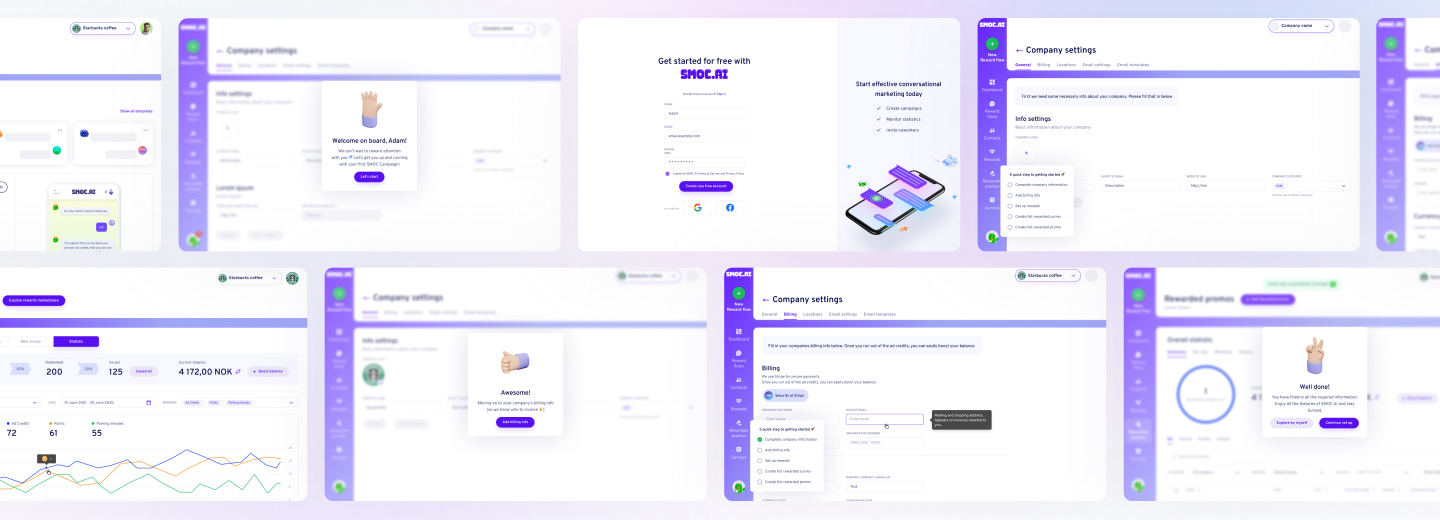
Scaling from Prototype into a User-Friendly and Conversational Marketing Platform
How to structure contracts for outcome based software development
This is where many outcome-based deals go wrong. Outcome-linked models sound attractive, but public-sector research has repeatedly shown that payment-by-results can fail when objectives, pricing, and triggers are vague. The UK National Audit Office has warned that these models are technically hard to design and are not suitable in every setting. GOV.UK guidance makes a similar point: outcome-based payment mechanisms need clear KPIs and clear payment events.
That advice applies directly to startup software contracts. If “success” is vague, conflict is almost guaranteed. If pricing is too aggressive, good vendors may walk away or under-resource the work. If payments depend on metrics the delivery team cannot reasonably influence, the model creates friction instead of focus.
A strong contract should define five things early:
- Business objective: what commercial or operational result the work is meant to improve
- Baseline: where the startup is today, measured before delivery starts
- KPI formula: how the result will be calculated and who validates it
- Payment trigger: what level of change unlocks milestone or bonus payments
- Risk boundary: which factors sit inside the team’s control and which do not
This is also why pure outcome pricing is uncommon in startup product work. Most startups change positioning, channels, pricing, and target users while the software is being built. A development partner can influence outcomes, but not fully control them. Marketing spend, sales quality, founder decisions, and market timing all affect results.
That is why hybrid models are often the most practical option.
How startups can evaluate a delivery partner beyond price
A startup should not ask only, “What will this team build?” It should also ask, “How will this team help us make better product bets?”
That shifts vendor evaluation in a useful way. Instead of rewarding the best sales deck or the lowest estimate, founders can assess whether the team has the operating model to produce measurable results.
Questions that usually separate strong partners from weak ones include:
- How do you define and track product outcomes?
- How do you handle scope changes without losing delivery predictability?
- What happens if the agreed KPI does not move?
- How do product, design, and engineering share accountability?
- Which metrics would you push us to baseline before build starts?
The answers should be specific. If a provider cannot explain how priorities are set, how experiments are evaluated, or how payment triggers are defined, the startup is likely buying activity rather than results.
What outcome based software development looks like during an MVP
For an MVP, the model should stay lean.
The goal is not to create a giant reporting framework. It is to connect early product decisions to market evidence. A strong MVP team will usually define the smallest release that can test it, define one core user problem, and agree on a few high-value signals. Activation, first transaction, task completion, or admin time saved are common starting points.
In startup delivery practice, this often means building only the core flows first. One recent MVP case centered on functions for posting requests, claiming tasks, managing profiles, and notifications, while product thinking, UX investigation, and scalable engineering supported changes in scope. That pattern is common in outcome-based work: smaller release, tighter measurement, faster decisions.
Founders do not need perfect certainty before starting. They do need a shared definition of what “better” looks like.
When that definition is clear, software delivery becomes a business system, not a procurement exercise. That is when outcome based development starts doing what it is supposed to do: turning product investment into measurable progress.

Need Checking What Your Product Market is Able to Offer?
EVNE Developers is a dedicated software development team with a product mindset.
We’ll be happy to help you turn your idea into life and successfully monetize it.
Conclusion
Outcome-based software development empowers startups to achieve measurable business results while optimizing resources and reducing risk. By aligning project goals with tangible outcomes, startups can ensure that every development effort directly contributes to growth and success. Choosing the right delivery model and a partner experienced in outcome-based approaches is essential for maximizing value and accelerating time-to-market. Embrace outcome-based software development to drive innovation, improve ROI, and build a scalable foundation for your startup’s future.
Outcome-based software development is a delivery model where success is measured by the achievement of specific business outcomes rather than just completing tasks or delivering features. This approach ensures that software projects deliver real value aligned with business goals.
It helps startups focus on results, optimize costs, reduce risks, and accelerate product-market fit by ensuring every development effort is tied to measurable business objectives.
Common models include time and materials, fixed price, and outcome-based models. Outcome-based models are increasingly popular for startups seeking flexibility and accountability.
Look for partners with proven experience in outcome-based delivery, transparent communication, and a track record of helping startups achieve measurable results.

About author
Roman Bondarenko is the CEO of EVNE Developers. He is an expert in software development and technological entrepreneurship and has 15+years of experience in digital transformation consulting in Healthcare, FinTech, Supply Chain and Logistics.
Author | CEO EVNE Developers