

 0
0

A SaaS MVP backlog can look tidy in week one, then turn into a crowded parking lot of “good ideas” by week three. Sales asks for enterprise toggles. Support wants fixes. Founders want differentiation. Engineering wants platform work. If you do not put a consistent scoring lens on top, prioritization becomes a debate about opinions, not outcomes.
Two lightweight systems work well together for MVPs: Opportunity Scoring to prove you are solving a real, painful problem, and RICE to decide what to ship first with limited time.
WHAT'S IN THE ARTICLE
- 01Why MVP backlogs get messy fast
- 02Start by locking the MVP goal and one primary metric
- 03RICE scoring, tuned for a SaaS MVP
- 04Opportunity Scoring to surface unmet needs
- 05When each method wins (and when it lies)
- 06A practical hybrid workflow: Opportunity first, RICE second
- 07Worked example: scoring an MVP backlog
- 08Making the numbers credible (without pretending you have perfect data)
- 09Common failure modes and how to prevent them
- 10Run a 60-minute prioritization session that actually sticks
- 11Conclusion
Why MVP backlogs get messy fast
MVP backlogs swell because “value” is ambiguous. A feature can be valuable to:
- A narrow but high-paying segment
- Many free users
- Internal teams trying to operate efficiently
- Your future roadmap, not your next release
Then there is effort. A one-week item that moves activation by 2% may beat a two-month item that moves it by 10%, depending on runway and deadlines.
A scoring approach does not remove judgment. It makes the trade-offs visible, consistent, and repeatable.
Start by locking the MVP goal and one primary metric
Before scoring anything, set the MVP’s job in one sentence and pick a primary metric you will protect. This prevents your scores from rewarding the wrong outcomes.
A practical MVP goal format is:
“For [target user], help them [complete a job] in [time/quality threshold], so we can validate [business model assumption].”
Then choose one primary metric, with 2 to 3 supporting metrics. Examples that work well in SaaS MVPs:
- Activation rate (first value moment completion)
- Week 4 retention (logo retention or user retention)
- Time to value (minutes or days)
- Trial to paid conversion
After you pick these, you can score features based on how strongly they are expected to move the metric, not how exciting they sound.
Here are quick MVP “guardrails” that reduce backlog noise:
- Metric definition written down
- Single target segment for the next release
- Clear non-go criteria for experiments that fail
RICE scoring, tuned for a SaaS MVP
RICE is a simple quantitative model popularized by Intercom. It answers: “Which item gives the most impact per unit of effort, given what we actually know?”
RICE = (Reach × Impact × Confidence) / Effort
For MVP planning, the key is to make each input measurable enough to compare items, even if you are early.
How to define each RICE input in MVP terms
Reach is not “total addressable market.” It is how many users, accounts, or key events will be affected within a fixed time window (often a month or a quarter). Pick one unit and stick to it.
Impact is the expected effect per reached user on the metric you chose. Many teams use a simple scale (3, 2, 1, 0.5, 0.25) to stay consistent.
Confidence is your honesty factor. If estimates are based on a few calls and a hunch, score lower. If you have strong analytics, pricing tests, or repeated interview patterns, score higher.
Effort is total team time to ship, not just engineering. Include product, design, QA, and compliance work when relevant.
After you define these once, scoring becomes fast.
A useful “input checklist” looks like this:
- Reach: accounts per month touched by the change
- Impact: expected lift on activation/retention per account
- Confidence: strength of evidence for Reach and Impact
- Effort: total person-weeks to get it live and reliable

Looking to Build an MVP without worries about strategy planning?
EVNE Developers is a dedicated software development team with a product mindset.
We’ll be happy to help you turn your idea into life and successfully monetize it.
Opportunity Scoring to surface unmet needs
Opportunity Scoring comes from Outcome-Driven Innovation thinking. It asks customers two questions for each outcome or capability:
- How important is this to you?
- How satisfied are you with current solutions?
A common formula is:
Opportunity = Importance + max(Importance − Satisfaction, 0) Many teams simplify it to 2×Importance − Satisfaction (with the same idea: high importance plus a dissatisfaction gap).
This is valuable for MVPs because it prevents a classic failure mode: building what seems impressive while missing what users are currently struggling with.
Opportunity Scoring works best when your “features” are written as outcomes, not UI wishes. “Invite teammates” is a feature. “Enable a manager to onboard a team in under 10 minutes” is an outcome. Outcomes score better because customers can judge them.
When each method wins (and when it lies)
RICE can over-rank items that are easy and broad, even if they do not address a painful gap. Opportunity Scoring can over-rank problems that are painful but expensive, risky, or hard to deliver inside an MVP window.
Used together, they cover each other’s blind spots:
- RICE helps you ship the right solution first.
- Opportunity Scoring helps you pick the right problems.
A practical hybrid workflow: Opportunity first, RICE second
This workflow fits most SaaS MVP teams and avoids week-long scoring exercises.
You start by collecting opportunity data, then apply RICE only to the short list that is truly worth building.
A clean sequence looks like this:
- Turn raw requests into 15 to 30 outcome statements.
- Collect Importance and Satisfaction via interviews plus a short survey (or structured calls if your market is niche).
- Rank by Opportunity score and take the top 5 to 10.
- Convert those outcomes into deliverable backlog items.
- RICE-score those items for the next release window.
After a paragraph of context in your backlog doc, the “scoring rules” can be captured as:
- Bold opportunity gap: Importance high, Satisfaction low
- Bold execution efficiency: high RICE score within the release window
- Bold evidence threshold: low confidence items require a test, not a build

Proving the Concept for FinTech Startup with a Smart Algorithm for Detecting Subscriptions
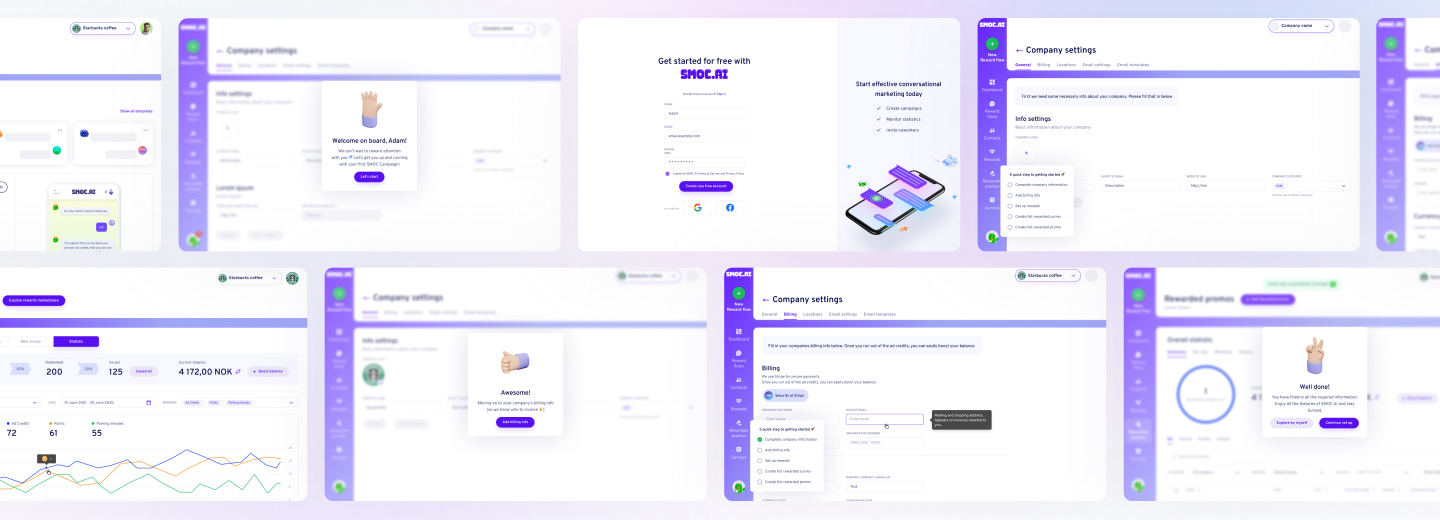
Scaling from Prototype into a User-Friendly and Conversational Marketing Platform
Worked example: scoring an MVP backlog
Assume a B2B SaaS MVP with 800 target accounts in the first quarter. Your primary metric is activation (accounts completing setup and running their first successful workflow).
You have five candidate items. First, you run Opportunity Scoring with prospects and early users (1 to 10 scale). Then you apply RICE on the top items.
| Backlog item (MVP scope) | Importance (1-10) | Satisfaction (1-10) | Opportunity (2×I − S) | Reach (accounts/qtr) | Impact (0.25-3) | Confidence | Effort (person-weeks) | RICE score |
| Guided onboarding checklist | 9 | 4 | 14 | 600 | 2 | 0.8 | 3 | 320 |
| Slack alert on failed workflow | 8 | 3 | 13 | 350 | 1.5 | 0.7 | 2 | 183.75 |
| Role-based access control (basic) | 7 | 6 | 8 | 250 | 1 | 0.6 | 4 | 37.5 |
| CSV import improvements | 6 | 4 | 8 | 500 | 1 | 0.7 | 3 | 116.7 |
| Custom branding | 5 | 7 | 3 | 200 | 0.5 | 0.6 | 2 | 30 |
What this tells you:
- The onboarding checklist and Slack alerts are both high opportunity and high RICE. They likely belong in the MVP release plan.
- CSV import is medium opportunity but solid RICE due to reach. It might be a “supporting” item if it unblocks onboarding.
- RBAC has decent reach but low RICE because effort is heavy relative to expected activation lift. If sales pressure is pushing it up, score it honestly and then decide if it is a strategic exception.
- Custom branding is low opportunity and low RICE. It is a clear “not now” unless your business model depends on it.
One sentence can save weeks here: if an item does not improve activation, retention, or revenue for your MVP segment, it needs a strong reason to stay.
Making the numbers credible (without pretending you have perfect data)
Early-stage teams rarely have clean analytics and stable cohorts. That is normal. The goal is not precision. The goal is defensible ranking.
To keep scoring grounded, decide how you will source each input:
- Reach: from funnel counts, CRM counts, or a realistic adoption assumption for the time window
- Impact: tied to a specific metric change (even if estimated with a small scale)
- Confidence: based on evidence quality, not optimism
- Effort: based on cross-functional sizing, including QA and release overhead
If you are operating in regulated domains, add effort for security review, audit logs, data retention, and compliance documentation. Those costs are real and they change the ordering.
Common failure modes and how to prevent them
Early-stage teams rarely have clean analytics and stabTeams usually struggle with RICE and Opportunity Scoring for predictable reasons: inconsistent definitions, gaming the numbers, and mixing strategy debates into a scoring session.
After you explain the purpose, set a few rules that keep the process honest:
- Bold Do not score raw requests: rewrite them into outcomes and testable hypotheses first
- Bold Treat confidence as a penalty: low evidence means lower scores or a research task
- Bold Keep effort cross-functional: include design, QA, DevOps, compliance, and rollout work
If stakeholders object to “math deciding,” frame it clearly: scoring is a decision support tool. Leadership can override scores, but overrides should be written down with the reason and the expected metric impact. That habit reduces repeated arguments later.le cohorts. That is normal. The goal is not precision. The goal is defensible ranking.
Run a 60-minute prioritization session that actually sticks
You can run a high-quality hybrid scoring workshop in one hour if you prepare. The trick is to pre-fill inputs, then use the meeting to correct assumptions, not to invent them.
Bring a short list of items, the evidence behind them, and an effort range from engineering. Then follow this cadence:
- Confirm the release goal and metric (5 minutes).
- Review opportunity gaps for the shortlist (15 minutes).
- RICE-score the top candidates quickly and consistently (25 minutes).
- Decide the top 3 to 6 items for the next iteration and log explicit exceptions (15 minutes).
A backlog that stays small, scored, and tied to a metric is easier to build, easier to explain, and easier to improve after launch.

Need Checking What Your Product Market is Able to Offer?
EVNE Developers is a dedicated software development team with a product mindset.
We’ll be happy to help you turn your idea into life and successfully monetize it.
Conclusion
A product-first delivery approach usually starts with discovery outputs that make scoring easier: a clear segment, a first value moment, and an instrumentation plan. Without those, both RICE and Opportunity Scoring become spreadsheet theater.
A practical structure that teams adopt is:
- A time-boxed discovery sprint to validate the problem and define success metrics
- A prioritized backlog with acceptance criteria for the first couple of sprints
- A measurement plan for activation, usage, and retention from day one
- Weekly reviews that remove backlog items that no longer support the metric goal
This style fits fast MVP timelines because it treats uncertainty as something to manage explicitly. Items with weak evidence are turned into quick tests instead of long builds, which protects runway and keeps delivery focused on business outcomes.
In conclusion, effectively prioritizing your SaaS MVP backlog is critical to building a product that delivers real value to users while maximizing your team’s resources. By leveraging frameworks like RICE and Opportunity Scoring, you can make data-driven decisions that align with your business goals and customer needs. These methods help you focus on features with the highest impact, reduce risk, and accelerate your path to product-market fit. Remember, backlog prioritization is an ongoing process, regularly revisit and adjust your priorities as you gather new insights and feedback. With a structured approach, your MVP will be well-positioned for success in a competitive SaaS landscape.
RICE stands for Reach, Impact, Confidence, and Effort. It’s a prioritization framework that helps product teams objectively score and rank features or initiatives based on their potential value and the resources required.
Opportunity Scoring is a method that evaluates features based on how well they satisfy user needs versus their importance to users. It helps identify high-impact opportunities for improvement by focusing on areas where user satisfaction is low but importance is high.
Yes, combining both frameworks can provide a more comprehensive view of your backlog. RICE helps with quantitative prioritization, while Opportunity Scoring brings in qualitative user insights.
It’s best to review your backlog regularly. at least every sprint or major release. Frequent reviews ensure your priorities stay aligned with evolving user feedback and business goals.

About author
Roman Bondarenko is the CEO of EVNE Developers. He is an expert in software development and technological entrepreneurship and has 10+years of experience in digital transformation consulting in Healthcare, FinTech, Supply Chain and Logistics.
Author | CEO EVNE Developers