

 0
0

Reaching Product-Market Fit is a monumental milestone. It is the moment when the chaos of early-stage startup life, starting from the endless pivoting, the desperate search for an audience, to the agonizing uncertainty, finally crystallizes into a predictable demand for your product. Investors celebrate, founders breathe a momentary sigh of relief, and the prevailing narrative shifts from “survival” to “growth.”
However, what many founders fail to realize is that the strategies, habits, and technical decisions that successfully carried the company to PMF are rarely the ones that will sustain it through the next phase of maturity. In the pre-PMF stage, speed is the ultimate currency. You move fast, break things, rely on monolithic MVPs, hardcode workarounds, and prioritize shipping over scalability. This scrappiness is necessary to survive.
But once you cross the PMF threshold, the game changes entirely. The risks shift from market rejection to operational collapse. The technical debt you accumulated to reach this point transforms from a necessary evil into a crippling liability. At this critical juncture, your software development approach must evolve. You must transition from a “feature factory” mindset to a culture of strategic, data-driven engineering and outcome-based delivery.
For startups looking to scale their operations, secure enterprise-level clients, and optimize their cloud infrastructure, the integration of data into every design and engineering decision is no longer optional. It is the bedrock of future success. This article explores why strategic software architecture, data-backed UX/UI design, and rigorous product discovery are the ultimate growth engines for post-PMF startups, and how you can implement these methodologies to build a resilient, scalable digital product.
WHAT'S IN THE ARTICLE
- 01The Post-PMF Inflection Point that Evolves Your Engineering Culture
- 02Strategic Software Architecture for Sustainable Scale
- 03The Imperative of Product Discovery as a Part of Curing Feature Bloat
- 04Data-Driven UI/UX Design and the Way of Engineering the User Journey
- 05Building a Culture of Observability and Backend Telemetry
- 06The Sales-Engineering Feedback Loop for Closing the Gap
- 07Conclusion
The Post-PMF Inflection Point that Evolves Your Engineering Culture
When a startup is searching for PMF, the engineering team is primarily focused on iteration speed. The goal is to get a functional concept into the hands of users as quickly as possible to test core assumptions. Code quality, scalable architecture, and comprehensive testing often take a backseat to the sheer necessity of getting the product out the door.
Once PMF is validated, this approach becomes dangerous. As your user base expands, so does the complexity of your codebase. Every new feature added to a brittle, hastily built foundation exponentially increases the risk of system failures, security breaches, and performance degradation. This is the technical debt trap.
To navigate this transition, leadership must foster a profound shift in the engineering culture. You must move away from output-driven metrics (how many features did we ship this sprint?) to outcome-based delivery (how did this release impact user retention, system latency, or customer acquisition cost?). Engineering is no longer just about writing code; it is about solving complex business problems through technology.
This cultural shift requires acknowledging that sometimes the most valuable engineering work involves not building new features, but rather engaging in strategic legacy system reengineering. Refactoring core components, optimizing database queries, and untangling monolithic architectures into streamlined services may not result in flashy new buttons for the marketing team to promote, but they are the silent prerequisites for long-term survival. Without this foundational work, your development velocity will inevitably grind to a halt as engineers spend the majority of their time fixing bugs and managing system outages rather than innovating.
Strategic Software Architecture for Sustainable Scale
As you target larger markets and enterprise-level clients, your software architecture must be capable of handling increased loads while maintaining uncompromising security and performance. This is where strategic software engineering takes center stage.
Early-stage MVPs are almost universally built as monoliths. The frontend, backend, and database logic are tightly coupled, which allows for rapid early development. However, as your team grows and your product expands, a monolithic architecture becomes a bottleneck. A single bug can take down the entire application, and deploying small changes requires redeploying the whole system.
Strategic engineering post-PMF often involves carefully decoupling these systems. Moving toward microservices or serverless architectures allows different parts of your application to scale independently. For example, if your application processes intense analytical reports at the end of the month, a microservices architecture allows you to scale up the specific services handling that load without unnecessarily scaling the entire application, leading to significant cloud cost optimization.
Furthermore, as you move upmarket, compliance and data security become primary sales drivers. Whether you are building fintech SaaS platforms that must adhere to strict PCI DSS standards, or navigating the complex data privacy requirements of GDPR in European markets, security can no longer be an afterthought patched onto the end of a sprint. It must be engineered into the architecture from day one. Privacy by design, encrypted data pipelines, and robust access controls are non-negotiable when enterprise clients are auditing your software before signing a contract.
This level of architectural sophistication requires a specialized approach. Partnering for custom software development can provide the deep technical expertise necessary to audit your existing infrastructure, map out a scalable architecture, and execute a phased reengineering plan that doesn’t disrupt your current users. Strategic engineering ensures that your technology stack is an asset that accelerates your B2B sales pipeline, rather than a liability that stalls enterprise negotiations.

Looking to Build an MVP without worries about strategy planning?
EVNE Developers is a dedicated software development team with a product mindset.
We’ll be happy to help you turn your idea into life and successfully monetize it.
The Imperative of Product Discovery as a Part of Curing Feature Bloat
A common pitfall for post-PMF startups is the assumption that because they have validated their core product, they inherently know what to build next. Buoyed by early success, companies often fall into the trap of “feature bloat”—endlessly adding new functionalities based on the loudest voices in the customer support queue, gut feelings from leadership, or a reactive desire to match competitors feature-for-feature.
This approach is highly inefficient and incredibly expensive. Writing code is the most resource-intensive way to validate an idea. By the time a feature is developed, QA tested, and deployed, you have invested thousands of dollars and weeks of engineering bandwidth. If the market doesn’t actually want that feature, the investment is entirely lost, and your codebase is permanently complicated by unused functionality.
The antidote to this inefficiency is robust, continuous Product Discovery. Discovery is not a phase that only happens before you launch a company; it is an ongoing, cyclical process that must precede every major development initiative.
Effective discovery involves deep market mapping, identifying shifting industry trends, and analyzing the genuine pain points of your target demographic. It requires interviewing users not to ask them what features they want, but to observe how they work and where they struggle. Users are notoriously bad at prescribing technical solutions, but they are experts at experiencing their own problems.
Before a single line of backend code is written, a strategic team will develop clickable prototypes, conduct A/B tests, and validate core assumptions with real users. They define strict validation criteria and measure the results. Only when the data proves that a feature will drive a specific business outcome—such as increasing user engagement, reducing churn, or opening a new market segment—does the initiative move into the engineering queue.
Investing in professional Product Discovery ensures that your engineering resources are deployed only against validated problems with guaranteed ROI. It aligns the development roadmap with actual market demands, keeping your product lean, focused, and highly relevant.
Data-Driven UI/UX Design and the Way of Engineering the User Journey
In the early stages of a startup, UI/UX design is often viewed through an aesthetic lens. Founders want the product to look modern, clean, and professional to build trust with early adopters. But post-PMF, design must transition from an art form to a measurable science.
Data-driven UI/UX design is about understanding that every pixel, every button placement, and every user flow has a direct, quantifiable impact on your bottom line. It is about engineering the user journey to minimize friction and maximize the desired outcomes.
To achieve this, design decisions must be rooted in behavioral data, not subjective opinions. You must implement robust product telemetry to track exactly how users navigate your application. Heatmaps reveal where users are clicking, scroll depth analysis shows how much content they actually consume, and session recordings can expose the exact moments where users experience confusion and abandon a workflow.
Consider the onboarding process. A complex, multi-step authorization and onboarding flow is one of the fastest ways to kill user retention. By analyzing drop-off rates at each specific step of the funnel, a data-driven design team can identify the exact fields or prompts that are causing friction. Perhaps users are abandoning the process because a form requires information they don’t have readily available, or because a CTA button is visually lost on a mobile screen.
This is particularly crucial in mobile application development, where screen real estate is limited and user patience is notoriously short. Designing for mobile requires an entirely different UX flow than desktop, optimising for touch targets, single-column layouts, and rapid interactions.
By continuously A/B testing design iterations against the baseline data, you can incrementally improve conversion rates, boost user retention, and significantly increase the Customer Lifetime Value. Good design makes the product look good; data-driven design makes the product profitable.

Proving the Concept for FinTech Startup with a Smart Algorithm for Detecting Subscriptions
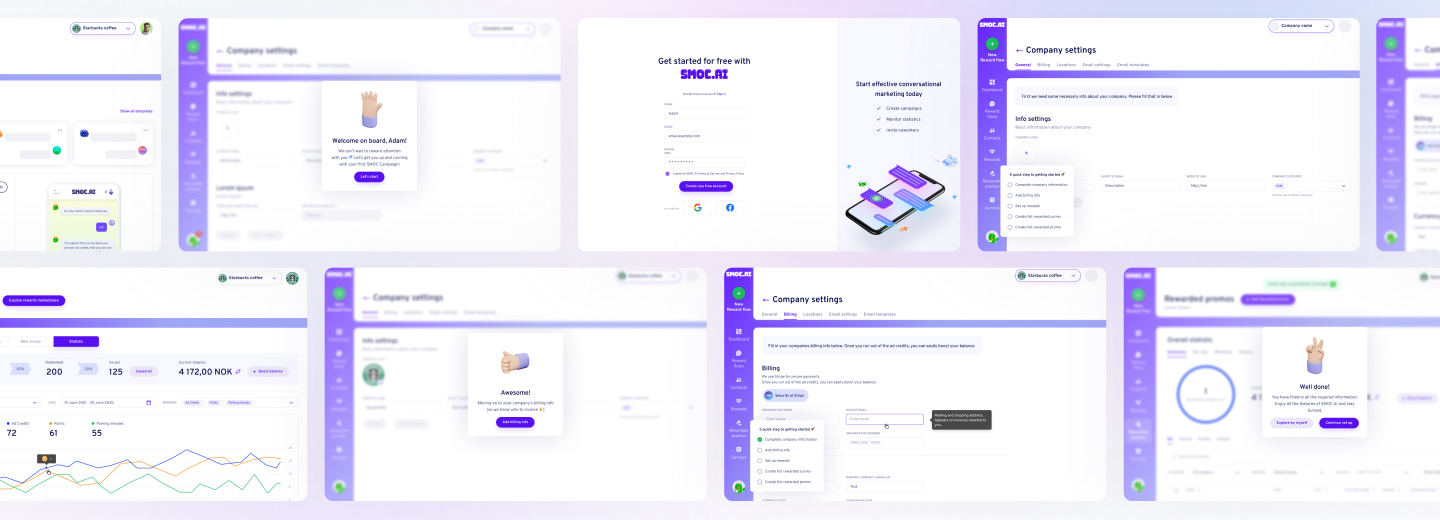
Scaling from Prototype into a User-Friendly and Conversational Marketing Platform
Building a Culture of Observability and Backend Telemetry
While data-driven design focuses on the frontend user experience, data-driven engineering applies the same rigorous, metric-based approach to the backend infrastructure. You cannot manage what you cannot measure, and running a post-PMF software company without deep backend observability is akin to flying a commercial airliner while blindfolded.
As your application scales, relying on user reports to identify bugs or performance issues is unacceptable. By the time a user submits a support ticket regarding a slow page load or a failed transaction, hundreds of other users have likely experienced the same issue and simply abandoned the application.
Strategic engineering requires the implementation of comprehensive Application Performance Monitoring and centralized logging. Your engineering team must have real-time visibility into the health of the entire system. This means tracking specific, granular metrics:
- What is the average response time of your most critical APIs?
- At what user load do your database queries begin to degrade?
- What is the error rate for third-party integrations?
This data is not just for preventing outages; it is the foundation of strategic decision-making. When engineering leadership has access to robust telemetry, they can definitively answer the question of whether to refactor or rebuild. They can identify the specific 20% of the codebase that is causing 80% of the performance bottlenecks.
Furthermore, this data is critical for cloud cost optimization. Without observability, the default solution to a slow application is often just to provision larger, more expensive servers. This “throw money at the problem” approach scales your costs much faster than your revenue. Data-backed engineering allows you to identify the specific inefficient algorithms or unindexed database queries causing the load, allowing you to fix the code rather than inflating your AWS or Azure bill.
The Sales-Engineering Feedback Loop for Closing the Gap
Finally, a truly strategic software development ecosystem does not silo engineering away from the commercial realities of the business. Post-PMF, the alignment between your B2B sales operations and your technical roadmap is a massive competitive advantage.
Too often, development teams build in a vacuum, completely disconnected from the objections the sales team is facing on the front lines. This creates a scenario where engineering is shipping features that users enjoy, but that do not actually help close new enterprise accounts.
To build a product that dominates its market, you must establish a rigorous feedback loop between sales and engineering. This involves conducting structured lost lead retrospectives. When a major B2B deal falls through, engineering leadership needs to understand exactly why from a technical standpoint.
- Did the prospect walk away because the platform lacked specific compliance certifications like GDPR or HIPAA?
- Was the integration ecosystem too closed off, preventing them from connecting your software to their existing middleware?
- Did they find the legacy UI too cumbersome during the product demo?
When engineering roadmaps are informed by lost lead data and sales pipeline friction, development shifts from a cost center into a direct revenue driver. Engineers begin building the specific architectural capabilities, security protocols, and API endpoints that sales needs to overcome objections and close larger contracts.
This alignment also extends to understanding specific industry nuances. If your company is targeting specialized, highly-regulated sectors, such as the emerging European deathtech/funeraltech markets, healthcare IT, or enterprise fintech, understanding the complex regulatory requirements and deeply entrenched legacy workflows of those specific industries must dictate the software architecture from the ground up. Generic SaaS solutions fail in these environments; highly specialized, data-informed, and securely engineered platforms thrive.

Need Checking What Your Product Market is Able to Offer?
EVNE Developers is a dedicated software development team with a product mindset.
We’ll be happy to help you turn your idea into life and successfully monetize it.
Conclusion
Surviving the journey to Product-Market Fit proves that your idea has value. But scaling that idea into a stable, highly profitable, and resilient technology company requires an entirely different playbook. The transition from a scrappy startup to a mature tech enterprise demands that you abandon the “move fast and break things” mentality in favor of precision, strategy, and evidence.
By investing in strategic software architecture, you build a foundation that can support massive scale and rigorous compliance demands. By committing to continuous product discovery, you ensure that every engineering hour is spent solving validated market problems. And by embedding data into every aspect of your UI/UX design and backend engineering, you transform your product from a static application into a self-optimizing growth engine.
The future success of your product will not be determined by how many features you can build, but by how intelligently you build them. Embrace the data, align your engineering with your business outcomes, and build a software ecosystem designed not just to survive, but to lead.
Product-Market Fit occurs when a digital product satisfies a strong market demand, meaning you have identified a clear target audience and built a solution that directly solves an urgent pain point. For digital products (like SaaS apps, digital downloads, or platforms), PMF is reached when retention stabilizes, users organically recommend the product, and customer acquisition costs drop relative to lifetime value.
An MVP is an experiment—the simplest version of your product built to test core hypotheses and gather early feedback. PMF is the destination—the validation stage where data proves your product effectively solves the target audience’s problem at scale. You build an MVP to start the journey toward achieving PMF.
Yes. PMF is not a static milestone; it is a continuous dynamic. Shifts in competitor technology, evolving consumer preferences, or macroeconomic changes can erode fit over time. Maintaining PMF requires ongoing product iteration, regular user interviews, and adapting features to match changing market expectations.
There is no universal timeline—it generally ranges from a few months to two years depending on market complexity and execution speed. B2C digital products with short feedback cycles can iterate quickly toward PMF in 3 to 6 months, while complex B2B SaaS solutions often take 12 to 24 months due to longer sales cycles, security compliance, and integration requirements.

About author
Roman Bondarenko is the CEO of EVNE Developers. He is an expert in software development and technological entrepreneurship and has 10+years of experience in digital transformation consulting in Healthcare, FinTech, Supply Chain and Logistics.
Author | CEO EVNE Developers