

 0


Most SaaS MVPs do not fail because the code is bad. They fail much earlier, when the team decides what to build, why to build it, and how success will be judged. The pattern shows up again and again: a product starts with a strong opinion about the solution, skips hard validation of the problem, adds too many features, and reaches launch with weak evidence that anyone really needs it. By that point, the team has spent money, burned time, and built momentum around assumptions instead of proof.
Recent guidance from Harvard Business School and startup research points to the same root issue. Teams often pitch the product before they can clearly show the customer problem, target user, or adoption path. Industry data on project failure says something similar from a delivery angle: poor requirements handling and vague communication sink outcomes long before release.
WHAT'S IN THE ARTICLE
- 01Why early SaaS product discovery breaks down
- 02Mistake 1: Starting with a solution before validating the problem
- 03Mistake 2: Treating the MVP like a smaller final product
- 04Mistake 3: Weak requirements and vague success criteria
- 05Mistake 4: Ignoring the buying process and adoption barriers
- 06Mistake 5: Letting stakeholder confidence replace customer evidence
- 07What strong SaaS product discovery looks like before MVP build
- 08Conclusion
Why early SaaS product discovery breaks down
Early discovery gets treated as a workshop, a backlog exercise, or a box to check before design and development. That is the first mistake. For an MVP, discovery should reduce uncertainty in three areas: the problem, the customer, and the learning goal. If those are still fuzzy, building faster only increases waste. Harvard Business School Online defines an MVP as the smallest set of features or capabilities that delivers the most learning in the least development time. That means the job of the MVP is not to look complete. Its job is to test a business-critical assumption.
When teams miss that point, they start measuring progress by output. Screens shipped. Stories closed. Integrations added. None of that proves demand.
| Product discovery mistake | What it looks like early | What it costs later |
| Starting with the solution | Demo-first thinking, weak customer evidence | Low adoption, weak retention |
| Vague MVP scope | “Just one more feature” planning | Delays, budget creep, bloated first release |
| Poor requirements clarity | Conflicting stakeholder expectations | Rework, missed deadlines, quality issues |
| No success metrics | Launching without a learning target | No decision framework after release |
| Ignoring buying barriers | Product fits users but not the buyer | Long sales cycles, stalled conversions |

Looking to Build an MVP without worries about strategy planning?
EVNE Developers is a dedicated software development team with a product mindset.
We’ll be happy to help you turn your idea into life and successfully monetize it.
Mistake 1: Starting with a solution before validating the problem
This is the most common early failure mode. Harvard Business School Working Knowledge has pointed out that many founders begin by pitching a solution before they can clearly explain the problem. That sounds minor, but it changes everything. If the team is already attached to the answer, research turns into confirmation. Interviews become leading. Feedback gets filtered. The result is a product shaped by hope.
Problem validation needs to be objective enough to challenge the original idea. A team should be able to answer basic questions with evidence: Who feels the pain? How often does it happen? What do they do today? What breaks in their current process? What is expensive enough, risky enough, or slow enough to trigger a buying decision?
If those answers are vague, the MVP scope is already unstable. Common warning signs show up early:
- Feature ideas arrive faster than customer evidence
- The team cannot name a clear job to be done
- Interviews focus on opinions, not behavior
- The target user and the economic buyer are mixed together
- The pain sounds interesting, but not urgent
A real SaaS opportunity usually has visible friction. Spreadsheets, manual workarounds, approval delays, compliance risk, revenue leakage, poor reporting, missed deadlines. If none of that is present, the product may be solving a mild annoyance instead of a painful problem.
Mistake 2: Treating the MVP like a smaller final product
Many teams say they want an MVP, then plan a version that includes every feature needed for months of sales conversations. That is not an MVP. It is a reduced roadmap.
The issue here is not ambition. It is sequencing. A first release should answer one major question at a time. Can this product attract a defined segment? Can users complete the core workflow? Will a buyer pay for this outcome? Can a team onboard without heavy support? When an MVP tries to answer all of those at once, scope expands and learning gets blurry.
This is where teams need a sharper hypothesis. A strong MVP is tied to a specific learning milestone, not a generic launch date. If the main risk is demand, build for demand proof. If the main risk is usability, build for repeated use. If the main risk is compliance or workflow fit, build enough to test that path and nothing more.
A practical MVP hypothesis usually includes:
- Target segment: who the first users or buyers are
- Pain point: the costly problem they already feel
- Core promise: the one outcome the MVP must deliver
- Success metric: the behavior that proves value
- Time horizon: when the team will review evidence and decide what happens next
This approach changes product conversations fast. Instead of asking, “What should we include in V1?” teams start asking, “What is the smallest release that can prove or disprove our main assumption?” That is a much better question.

Proving the Concept for FinTech Startup with a Smart Algorithm for Detecting Subscriptions
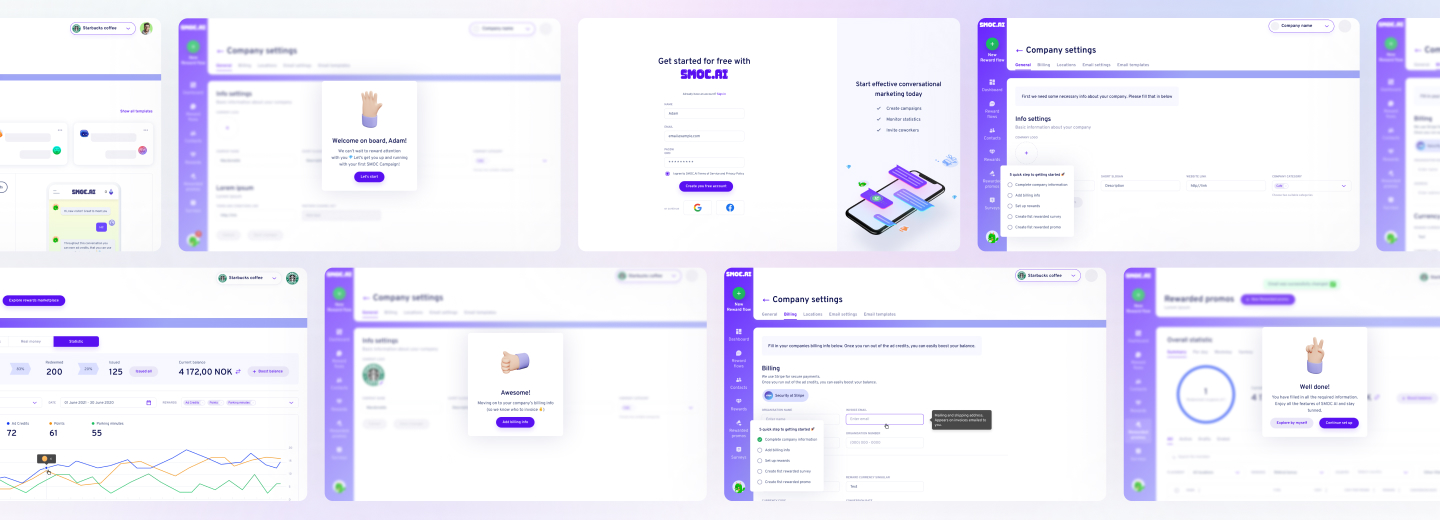
Scaling from Prototype into a User-Friendly and Conversational Marketing Platform
Mistake 3: Weak requirements and vague success criteria
Even when the opportunity is real, SaaS MVPs still get into trouble when requirements are loose, inconsistent, or spread across too many voices.
The Project Management Institute reported that nearly half of unsuccessful projects fail to meet goals because of poor requirements management. It also found that when communication is a main cause of failure, poor communication affects requirements more than any other project area. That matters for startups and SaaS teams because discovery often happens in a high-speed environment where assumptions multiply fast.
Weak requirements do not always look like missing documents. Sometimes they look polished. There is a roadmap, a Figma file, a feature list, maybe even user stories. Yet the team still has no shared meaning behind key terms. “Admin” means one thing to product, another to engineering, and something else to the buyer. “Reporting” could mean a dashboard, exports, scheduled emails, or audit trails. “Enterprise-ready” might secretly include role-based access, SSO, logging, approval flows, and data retention rules.
That gap creates expensive rework. Good requirements for an MVP should not be heavy. They should be precise. A team needs clear definitions for core workflows, user roles, data rules, edge cases that matter now, and what will be left out on purpose. Just as important, success criteria must be visible before development starts. If the team cannot say what good looks like, launch will create debate instead of answers.
Mistake 4: Ignoring the buying process and adoption barriers
A product can solve a real user pain and still fail because nobody studied how it gets approved, purchased, and adopted. The Harvard Business School Rock Center for Entrepreneurship has highlighted this issue directly: teams often move toward a solution without validating the need, and they also miss the full buying process and adoption barriers. In SaaS, that is a major risk. The person who feels the pain may not control the budget. The manager who approves the tool may worry about compliance, reporting, training effort, or switching costs. A procurement team may care about legal terms before features.
This matters even more in regulated or operationally complex categories. A useful MVP in fintech, healthcare, insurance, education, energy, or real estate may need to prove trust as much as functionality.
Adoption barriers often look like this:
- Security review delays
- Manual onboarding effort
- Data migration concerns
- Approval chain friction
- Low willingness to change habits
A team that ignores these issues can get encouraging interview feedback and still struggle to close the first customers. The MVP may be “good enough” for a user, but not “safe enough” for a buyer.
Mistake 5: Letting stakeholder confidence replace customer evidence
Internal confidence is loud. Customer evidence is often slower, messier, and less comfortable. Founders, product leaders, sales teams, and technical leads usually have strong opinions about what should be built first. That is normal. The problem starts when those opinions are treated as proof. Teams end up ranking features by influence, not by risk reduction.
CB Insights has analyzed hundreds of startup post-mortems and found that failure to find a market remains one of the biggest reasons young companies struggle. A large share of product-market-fit failures happen early. The lesson is clear: conviction is not validation.
This is why disciplined discovery uses direct evidence wherever possible. Interviews based on recent behavior. Problem-validation tests. Landing pages. Waitlist conversion. Click tests. Concierge workflows. Pilot usage. Trial-to-activation rates. Pre-sales conversations with clear qualification criteria. These are not perfect, but they are much stronger than a meeting-room consensus.
What strong SaaS product discovery looks like before MVP build
Strong discovery does not need to take months. In many SaaS cases, focused discovery work can happen in a few weeks, while broader or more regulated products may take longer. The point is not duration. The point is reducing the right risks before build momentum makes change expensive.
A solid discovery phase usually ends with a small set of decisions, not a giant document. The team should know the target segment, the job to be done, the main problem evidence, the MVP hypothesis, the first success metric, core requirements, top adoption constraints, and what will not be built yet.
That last item matters a lot. Exclusions protect the MVP from becoming a “starter version” of the full product. If a feature does not support the first learning milestone, it should probably wait.
A reliable pre-build package often includes:
- Problem evidence: what users do today, where the pain shows up, and why it matters now
- Segment definition: the first audience, buyer role, and usage context
- MVP scope: the few workflows needed to test the core promise
- Success metrics: activation, retention, conversion, or another learning metric tied to the main risk
- Decision rules: what results justify iteration, expansion, or stopping
When those pieces are clear, execution gets faster for the right reason. Fewer debates. Less rework. Better handoff between business, design, and engineering. A launch that teaches something useful.
Questions that should be answered before any SaaS MVP starts development
If a team cannot answer these clearly, the product is probably not ready for development.
- What painful problem are we proving: not what feature we want to ship
- Who feels it most often: not the broad market, but the first best segment
- What behavior will prove value: activation, repeated use, pilot conversion, paid commitment
- What is the smallest release that can test that behavior: not a roadmap slice, but a learning slice
- What could block adoption even if users like it: compliance, onboarding, approvals, migration, trust
That discipline may feel slower in week one, but it usually saves months by week twelve.

Need Checking What Your Product Market is Able to Offer?
EVNE Developers is a dedicated software development team with a product mindset.
We’ll be happy to help you turn your idea into life and successfully monetize it.
Conclusion
Avoiding common product discovery mistakes is critical to the early success of your SaaS MVP. By validating assumptions, engaging real users, and iterating based on feedback, you can reduce risk and build a product that truly solves customer problems. Remember, effective product discovery is an ongoing process that sets the foundation for sustainable growth and market fit.
Product discovery is the process of understanding customer needs, validating ideas, and defining the right features to build before developing a SaaS product.
MVPs often fail due to skipping user research, relying on assumptions, or not iterating based on real feedback, leading to products that don’t solve actual problems.
Engage with real users early, validate your assumptions with data, iterate quickly, and focus on solving a specific problem rather than building too many features at once.
Low user engagement, high churn rates, and feedback that your product doesn’t meet user needs are common indicators of ineffective product discovery.

About author
Roman Bondarenko is the CEO of EVNE Developers. He is an expert in software development and technological entrepreneurship and has 15+years of experience in digital transformation consulting in Healthcare, FinTech, Supply Chain and Logistics.
Author | CEO EVNE Developers