

 0
0

Founders usually ask the question as if it were a fork in the road: should we hire an AI consultant, or should we hire an AI development team? In most cases, that framing is too narrow. The real choice is about sequence, depth, and business risk. A startup trying to validate one workflow problem has very different needs from an enterprise team rolling out AI into a regulated product. One may need a fast use-case filter and a lean proof of concept. The other may need data governance, workflow redesign, model selection, integration, testing, and change management.
That difference matters because AI adoption is moving from curiosity to operational planning. U.S. Census Bureau data showed estimated business AI use rising from 3.7% in September 2023 to 5.4% in February 2024, with 6.6% expected by early fall 2024. The same research also found that companies were not just buying tools. They were training staff, creating new workflows, and adding cloud services and storage. That is a strong signal for founders: AI value is rarely just a model plugged into a product.
WHAT'S IN THE ARTICLE
- 01What AI consulting means for founders
- 02What AI development means in practice
- 03Key differences between AI consulting and AI development
- 04Why most AI products need both consulting and development
- 05When founders should start with AI consulting
- 06When founders can move straight to AI development
- 07AI consulting vs AI development in regulated industries
- 08What a practical founder-friendly engagement looks like
- 09Conclusion
What AI consulting means for founders
AI consulting is the strategic layer before, around, and sometimes during implementation. It focuses on whether AI should be used, where it will create measurable value, what data is available, what risks need control, and how the business process may need to change.
For founders, good consulting should reduce wasted build effort. It should pressure-test the use case, estimate ROI, identify data gaps, and expose compliance concerns before engineering time gets expensive. In a practical setting, consulting often covers product discovery, workflow mapping, risk framing, vendor or model selection, and success metrics.
It also helps answer a tougher question: if the AI works technically, will the business actually benefit? A useful AI consulting scope often includes:
- Use-case selection: Pick problems where accuracy, speed, cost savings, or automation can be measured
- Data readiness review: Check data quality, access, labeling needs, and security constraints
- Risk and governance review: Map privacy, bias, compliance, and human oversight needs
- Workflow design: Define how people, systems, and AI outputs fit together
- MVP planning: Decide what to test first and what should wait
This is why consulting is often strongest at the front end of an AI initiative, especially when the founder has a broad goal but no clear path to value.
What AI development means in practice
AI development is the build phase. It turns a chosen use case into working software, models, integrations, interfaces, and production workflows. That may include prompt engineering, model orchestration, retrieval systems, dataset preparation, evaluation pipelines, backend services, APIs, UX, monitoring, security controls, and cloud deployment. In customer-facing products, it also includes latency, fallback logic, audit trails, and support for edge cases.
EVNE Developers describes its AI development work as covering enterprise AI development, AI chatbot development, and PoC or MVP development. Its stated process includes use-case evaluation, data augmentation, and responsible AI framing. That matters because development is not only coding. It is coding attached to performance, safety, and product outcomes.
Common AI development outputs include:
- Working prototype
- Production-ready backend
- LLM or ML integration
- Admin tools and dashboards
- Monitoring and evaluation setup
- Security and compliance controls
A founder should expect development work to answer very concrete questions: How accurate is the output? How fast is it? What happens when confidence is low? How does it connect to existing systems? Can it be maintained by the internal team later?

Looking to Build an MVP without worries about strategy planning?
EVNE Developers is a dedicated software development team with a product mindset.
We’ll be happy to help you turn your idea into life and successfully monetize it.
Key differences between AI consulting and AI development
The two disciplines overlap, but they solve different problems. Consulting reduces uncertainty before major investment. Development reduces distance between idea and production. Consulting asks, “What should we build, and under what rules?” Development asks, “How do we build it so it works reliably at scale?” Here is a practical way to separate them:
| Area | AI consulting | AI development |
| Primary goal | Select the right use case and plan value creation | Build, test, deploy, and improve the solution |
| Main output | Strategy, roadmap, risk plan, MVP scope | Working product, integration, monitoring, release plan |
| Typical team | Product strategist, AI consultant, data expert, business analyst | ML engineers, software engineers, designers, QA, DevOps |
| Best starting point | Unclear use case, unclear data, unclear ROI | Clear use case, approved scope, available data |
| Success measure | Better decisions and lower project risk | Product performance and business metrics |
| Common failure mode | Strategy with no execution path | Expensive build with weak business fit |
Founders sometimes assume consulting is “just advice” and development is “the real work.” That is a costly mistake. Bad consulting leads to teams building the wrong thing. Bad development leads to a solid demo that fails in production.
Why most AI products need both consulting and development
The strongest AI products usually need both, because AI introduces two hard problems at once: system building and operating model change. NIST’s AI Risk Management Framework treats AI risk management as relevant across pre-design, design, development, deployment, use, and test and evaluation. That is a useful frame for founders. Risk is not something to bolt on after launch. It needs to shape the product from the first decisions about data, prompts, workflow, and user permissions.
McKinsey has also argued that enterprise AI value often depends less on adding tools and more on redesigning workflows and operating models. In the cited research, only 21% of companies had fundamentally redesigned their operating models around AI. Top performers were three times more likely to pursue broader redesign and twice as likely to redesign workflows before selecting tools. That point is easy to miss.
If a company keeps the same approval process, the same handoffs, the same data delays, and the same accountability model, AI may speed up one step while the full workflow stays slow and expensive.
The Census findings support that pattern too. Businesses adopting AI reported organizational changes, including staff training, new workflows, and added cloud services or storage. That tells founders something important: implementation is not limited to model quality. Teams, processes, and infrastructure move with it.

Proving the Concept for FinTech Startup with a Smart Algorithm for Detecting Subscriptions
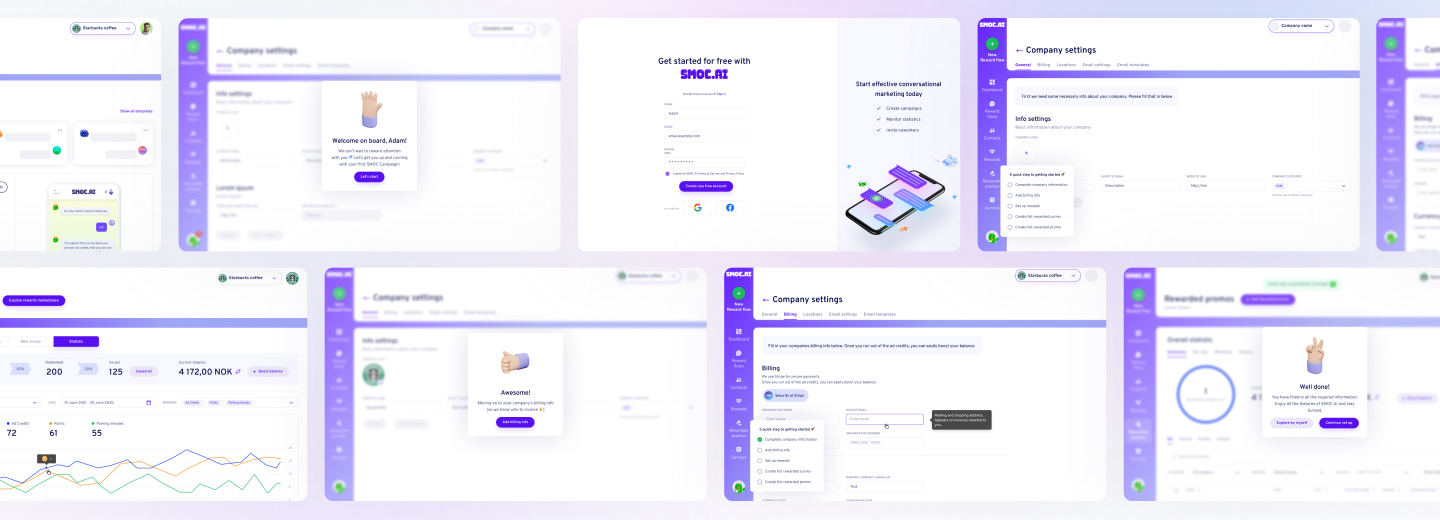
Scaling from Prototype into a User-Friendly and Conversational Marketing Platform
When founders should start with AI consulting
Start with consulting when the use case feels promising but still fuzzy. This is common in early-stage companies that want “an AI feature” because the market expects it, or in larger firms where multiple departments have competing ideas. Consulting is also the better entry point when the data situation is messy, compliance needs are heavy, or leadership wants ROI estimates before approving a build.
A founder should favor consulting first when several of these are true:
- Problem first, solution unclear: The team knows the business pain but not whether AI is the right fix
- Data risk is high: Sensitive records, fragmented systems, or low-quality historical data
- Workflow impact is broad: The product will change team roles, approvals, or customer support paths
- Regulation is material: Healthcare, insurance, fintech, education, or any environment with privacy duties
- Budget pressure is tight: The company needs a small, defensible MVP plan before committing engineering spend
In these cases, consulting shortens the path to a better build. It may feel slower for a week or two, but it often saves months.
When founders can move straight to AI development
Some teams do not need a long strategy phase. They already know the use case, the desired outcome, the data source, and the product surface where AI belongs. A good example is a company that wants to add a support copilot to a SaaS platform, has years of clean support documentation, and only needs limited workflow change. Another is a product team that has already run manual tests with internal users and knows exactly which task should be automated first.
Move directly into development when the basics are already validated:
- Clear user problem
- Defined success metric
- Available and lawful data
- Known technical constraints
- Stakeholder approval
- A realistic MVP boundary
Even then, smart development teams still do some consulting work inside the build. They validate assumptions, shape prompts and workflows, define evaluation criteria, and set guardrails. The difference is that strategy and implementation happen in a tighter loop.
AI consulting vs AI development in regulated industries
In regulated or high-trust sectors, the line between consulting and development gets even thinner. A healthcare product cannot treat model choice as a stand-alone engineering decision. A fintech platform cannot ignore auditability. An insurance workflow cannot skip privacy controls when images or documents are processed. In these environments, consulting informs architecture, and architecture affects compliance.
That is why founders in these sectors should ask more than “Can you build it?” They should ask how the team handles data minimization, human review, model evaluation, incident response, access control, prompt injection risks, retention policies, and user transparency. NIST’s lifecycle framing is useful here because it keeps risk, test, and deployment connected instead of treating them as separate tracks.
What a practical founder-friendly engagement looks like
The most effective setup is rarely pure strategy or pure delivery. It is a phased engagement with clear business gates.
A typical path looks like this:
- Short discovery focused on use case, data, workflow, and ROI
- MVP definition with risk controls and evaluation criteria
- Prototype or proof of concept
- Production build with integrations, monitoring, and governance
- Post-launch iteration tied to usage and business metrics
That approach fits both startups and larger firms because it keeps spending tied to evidence.
Case studies help show what that looks like in practice when consulting and development are connected to operational outcomes. In one insurance-related project, the company states that a car accident reporting system integrated with the NAIC Registry to automatically retrieve vehicle details and reduce recording errors. The same case study says DALL-E-based image processing was used to blur license plates and faces for privacy compliance, and that an AI-powered voice chatbot helped answer accident-reporting questions and reduce reporting time.
That is not “AI for AI’s sake.” It is workflow-centered product building: data retrieval, privacy control, and customer guidance inside one process.
Another case study on a custom LLM project says the platform had 400 users before launch, used multiple proprietary datasets, and achieved a 3x faster response rate. That points to a pattern founders should look for: start with a real user base or a realistic test group, train or ground the system on relevant domain data, and measure the effect on speed or productivity.
A strong engagement model should give founders these signals:
- Business metric first: Time saved, conversion lifted, error rate reduced, or support load lowered
- Workflow fit: AI placed inside the real operating process, not bolted on as a demo
- Risk controls early: Privacy, access, testing, and fallback logic planned before launch
- Incremental release: PoC, MVP, and scale-up tied to evidence rather than hype
That is usually the best answer to the consulting-versus-development question. Founders do not need a philosophical distinction. They need a path that moves from uncertainty to measurable results without skipping governance, workflow design, or production discipline.

Need Checking What Your Product Market is Able to Offer?
EVNE Developers is a dedicated software development team with a product mindset.
We’ll be happy to help you turn your idea into life and successfully monetize it.
Conclusion
Choosing between AI consulting and AI development depends on your startup’s current needs, resources, and long-term vision. AI consulting is ideal for founders seeking strategic guidance, risk assessment, and a clear roadmap before investing in technology. AI development is the next step for those ready to build, implement, and scale AI solutions tailored to their business. By understanding the differences and benefits of each, founders can make informed decisions that maximize ROI and accelerate growth in an increasingly AI-driven market.
AI consulting focuses on strategy, planning, and identifying opportunities for AI within your business. AI development involves building, deploying, and maintaining AI solutions.
Startups should consider AI consulting when they need expert advice, want to validate ideas, or require a roadmap before committing to development.
Yes. Many successful companies start with consulting to define their strategy and then move to development to execute their vision.
If you have a clear use case, validated data, and buy-in from stakeholders, you’re likely ready to move from consulting to development.

About author
Roman Bondarenko is the CEO of EVNE Developers. He is an expert in software development and technological entrepreneurship and has 15+years of experience in digital transformation consulting in Healthcare, FinTech, Supply Chain and Logistics.
Author | CEO EVNE Developers