

 0
0

Scope creep in an MVP rarely starts with a dramatic pivot. It starts with a reasonable request that feels “small.” Then another. Then a “quick win” that turns into a dependency chain. By the time leadership realizes the first release is drifting, the launch date has moved, the team is context-switching, and the product no longer tests a clear hypothesis.
An MVP is not “version 0.9.” It is a controlled experiment that answers a few high-stakes questions with the smallest reliable build.
WHAT'S IN THE ARTICLE
What MVP scope creep actually looks like
MVP scope creep is any expansion that weakens the original validation plan. It can show up as extra features, broader platforms, more user types, new integrations, or compliance and security work that is real and necessary, just not necessary for the first learning milestone.
It often hides behind phrases like “while we’re here,” “just add settings,” or “we’ll need this later anyway.”
Teams tend to notice it late because each change, evaluated alone, looks rational.
After a paragraph of debate, the backlog grows.

Looking to Build an MVP without worries about strategy planning?
EVNE Developers is a dedicated software development team with a product mindset.
We’ll be happy to help you turn your idea into life and successfully monetize it.
Why it happens even with experienced teams
Most product leaders already know the textbook answer: prioritize. The harder truth is that MVP creep is usually a leadership and system design issue, not a willpower issue.
Common drivers include:
- Ambiguous success criteria, where “ship MVP” is the goal instead of “validate X behavior from Y users.”
- Stakeholder anxiety, especially when investors, executives, or key customers want the product to look “complete.”
- Sales-led promises made before the product has a stable core.
- Unclear ownership, where nobody has final authority to say “not in this release.”
- Technical uncertainty, which triggers “let’s build it robustly now” thinking.
A useful mindset shift is to treat scope decisions as risk decisions. Every “nice to have” inserted into the MVP is a bet that it reduces risk more than it increases time, complexity, and coordination costs.
Practical steps on score creep avoidance
The MVP boundary: define it like a contract
The fastest way to cut scope creep is to make the boundary explicit and easy to reference during tense conversations. We suggest writing the MVP boundary in three layers:
- Value promise: the single job the MVP helps users complete.
- Target user: who it is for and who it is not for.
- Success metric: the observable behavior that proves the promise is real.
This does not need to be long. It needs to be unambiguous.
Product leaders can also document early warning signals. This makes creep visible before it becomes expensive.
- “Just one more screen”
- “It’s only a small integration”
- “We can ship it behind a toggle”
- “Let’s support both workflows”
- “We’ll clean it up after launch”
Prioritization that survives real pressure
Frameworks work best when they become a shared language across product, engineering, design, and stakeholders. Two that consistently help MVP teams stay disciplined are MoSCoW and RICE.
MoSCoW is strong at clarifying what will not ship. RICE is strong at turning arguments into comparable scores when there are many plausible options.
Here’s a simple comparison that teams can reuse in planning sessions.
| Framework | What it answers | Strength for MVP work | Watch-out |
| MoSCoW (Must, Should, Could, Won’t) | “Is it in or out for this release?” | Forces a visible “Won’t” list that protects the MVP boundary | Teams sometimes label too many items as Must |
| RICE (Reach, Impact, Confidence, Effort) | “Which option buys the most outcome per effort?” | Reduces opinion-driven debates by using a repeatable scoring method | Early-stage products may have low Confidence, so scores need honest assumptions |
| User story mapping (thin slice) | “What is the minimum end-to-end journey?” | Keeps scope anchored to completing the core job, not to a feature inventory | If the slice is too thin, it can become a demo that users cannot complete |
A practical approach is to run MoSCoW first to set guardrails, then use RICE only within the “Must” and “Should” candidates when trade-offs remain.
Build the “thin slice” before debating the extras
Story mapping is a reliable antidote to MVP creep because it makes teams think in user outcomes, not feature lists. The goal is to ship the smallest end-to-end flow that still produces real learning.
That “thin slice” typically includes:
- One primary user journey, start to finish
- One happy path that works reliably
- One measurement loop that tracks the key metric
It may feel uncomfortable because it excludes many common expectations. That discomfort is information. It tells you where stakeholders are confusing “polish” with “proof.”
A change request is not a task. It is a decision.
Once development starts, the main control point is not the backlog. It is the decision process used when new requests appear.
A lightweight change control process does not mean bureaucracy. It means every request is forced through the same filter before it enters the sprint.
A simple triage script can keep teams consistent:
- Proposed change: what is being asked for, in one sentence.
- User impact: which user behavior changes if it ships now.
- MVP metric impact: whether it improves the metric being validated, and how.
- Cost and risk: delivery impact, new dependencies, security or compliance implications.
- Decision: now, later, or never, with an owner and a date to revisit if “later.”
When teams write these down, two things happen: stakeholders become more thoughtful with requests, and “quick adds” stop bypassing accountability.
Stakeholder communication that prevents last-minute surprises
Scope creep accelerates when stakeholders first see the product late. Early visibility keeps feedback timely and keeps decisions anchored to evidence.
Cadences that work well:
- Weekly demos that show the real build, not slides.
- A shared MVP one-pager that is updated only when decisions change.
- A visible Won’t list that is treated as part of the plan, not a rejection.
This is where product leadership has to be direct. A stakeholder request can be valuable and still be deferred. The key is to connect the deferral to the MVP metric, not to personal preference.
A useful phrasing is: “Yes, and it makes sense for iteration two. For this release we are proving X, so we cannot add anything that does not move X.”
Engineering choices that reduce creep without blocking growth
Some scope creep comes from legitimate engineering concerns. Teams worry that shipping “too small” will cause rewrites later. The fix is to separate product scope from engineering quality.
An MVP can be minimal and still be built responsibly.
Good technical practices for MVP scope control include:
- Designing for change at boundaries: clear APIs, modular services, or clean separation between UI and domain logic.
- Using feature flags carefully: only when they reduce release risk, not to hide unfinished work.
- Avoiding premature multi-tenancy, advanced roles, or complex permissions unless the MVP hypothesis requires them.
- Planning compliance work in “gates”: only the controls required for the first user cohort and deployment context.
In regulated domains, “minimal” does not mean “casual.” It means the smallest compliant product for the chosen go-to-market path.

Proving the Concept for FinTech Startup with a Smart Algorithm for Detecting Subscriptions
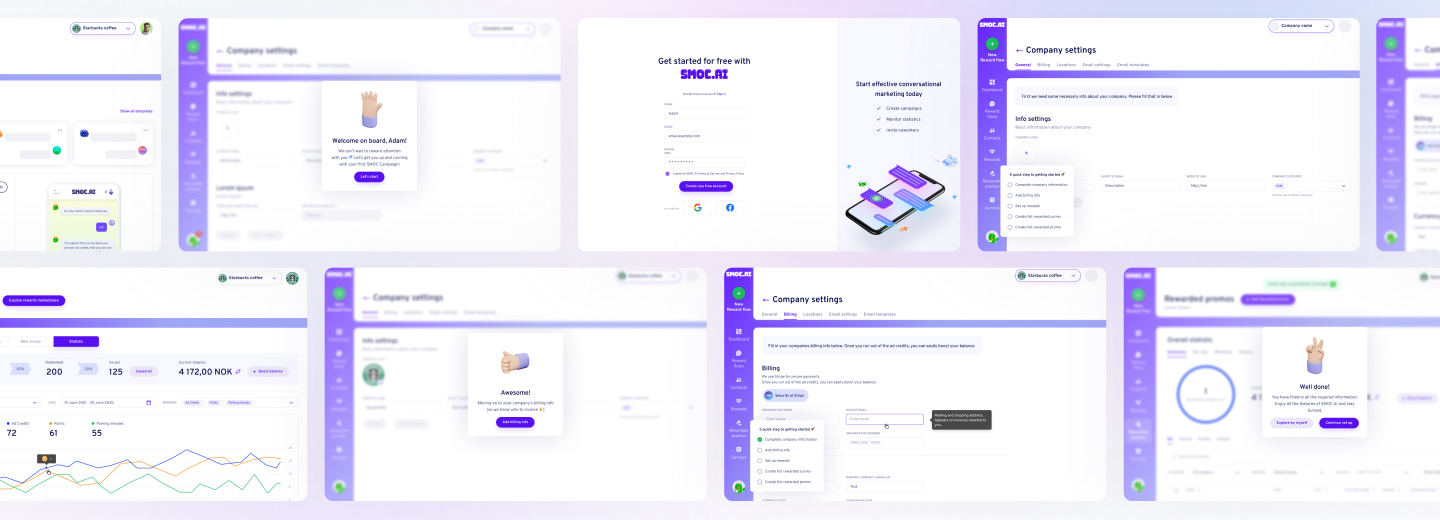
Scaling from Prototype into a User-Friendly and Conversational Marketing Platform
A practical “laser-focused MVP” scorecard
If you want a fast way to tell whether your MVP is drifting, use a scorecard that turns ambiguity into a quick diagnosis. Ask these questions in sprint planning and in stakeholder reviews.
- Does every Must-have map to the core user journey?
- Can someone explain the MVP metric without referencing features?
- If a feature is removed, can the MVP still validate the hypothesis?
- Are new requests being captured with a clear “now vs later” decision?
- Do stakeholders see the product every week?
If the answer is “no” to any of these, you do not have a scope problem. You have a decision system problem.
Fix the system, and scope discipline becomes the default behavior.

Need Checking What Your Product Market is Able to Offer?
EVNE Developers is a dedicated software development team with a product mindset.
We’ll be happy to help you turn your idea into life and successfully monetize it.
How EVNE Developers approaches scope control on MVPs
At EVNE Developers, MVP scope control is treated as a product discipline, not as a project constraint. Teams are set up to ship a focused release, measure it, and iterate based on what users do, not what stakeholders assume.
A typical engagement pattern includes:
- Product discovery that pins down the hypothesis, target user, and measurable success criteria before build work accelerates.
- A prioritized scope that explicitly calls out what is excluded from release one, so stakeholders can agree while trade-offs are still cheap.
- Lean-Agile delivery in short cycles with regular demos, keeping feedback frequent and decisions timely.
- Metrics planning early, so instrumenting the product is not treated as “extra work” when the launch date gets close.
This approach is especially helpful for project rescue situations, where the real problem is not velocity. It is a backlog that has become a wishlist with no single decision rule.
MVP scope creep occurs when additional features, requirements, or changes are added to a minimum viable product (MVP) beyond its original, essential scope. This often leads to delays, increased costs, and a diluted product vision.
Scope creep undermines the core purpose of an MVP, which is to quickly validate assumptions and gather feedback with minimal resources. It can slow down time-to-market, increase development costs, and make it harder to learn from real users.
Common signs include frequent changes to requirements, pressure to add “just one more feature,” missed deadlines, and a growing list of features that weren’t part of the original plan.
In rare cases, scope creep can reveal critical user needs that were previously overlooked. However, these insights should be carefully weighed against the MVP’s objectives and only included if absolutely necessary.

About author
Roman Bondarenko is the CEO of EVNE Developers. He is an expert in software development and technological entrepreneurship and has 10+years of experience in digital transformation consulting in Healthcare, FinTech, Supply Chain and Logistics.
Author | CEO EVNE Developers