

 0
0


Death is still one of the least “productized” moments in modern life. Families are forced into rushed decisions, paper-heavy administration, and fragmented services right when their attention and capacity are at their lowest. That gap is exactly why deathtech is gaining traction across Europe.
After a decade of building and rescuing digital products, one pattern stands out: markets that look “too sensitive” or “too complex” often become the most defensible when you solve them with care, compliance, and clear business outcomes. Europe is a prime example. It is large, wealthy, aging, digitally capable, and legally fragmented enough that strong execution becomes a moat.
WHAT'S IN THE ARTICLE
- 01What Deathtech includes and why Europe behaves differently
- 02Demand signals: demographics, cost pressure, and digital spillover
- 03Regulation and trust-by-design: GDPR is the business model
- 04Business models that work in Deathtech (and what breaks)
- 05Building an MVP that survives real bereavement conditions
- 06What the next few years in Europe are likely to reward
- 07Conclusion
What Deathtech includes and why Europe behaves differently
Deathtech is the set of digital products and platforms that support end-of-life planning, funeral arrangement, estate administration, memorialization, bereavement support, and the operational backbone for the businesses that serve families. In Europe, it spans both consumer apps and deep B2B software for funeral homes, insurers, employers, care providers, and public sector workflows.
Europe behaves differently from the US for three reasons.
First, regulation is not “a box to tick.” GDPR shapes data models, onboarding flows, consent capture, retention logic, and vendor selection from day one. Second, country-by-country differences matter more than founders expect: inheritance processes, funeral rules, and even who is allowed to handle specific tasks varies across borders. Third, trust requirements are higher. If your product mishandles identity, payment timing, or data access around a death, you do not just lose a customer. You lose the category.
This is also a market where brand voice, UX writing, and operational readiness are part of product quality, not marketing polish.
Where European Deathtech innovation is clustering
Deathtech in Europe is not one market. It is a portfolio of adjacent problems that can be solved independently, then connected over time into broader platforms.
Most activity clusters into a few product shapes:
- online wills and end-of-life planning
- probate and estate administration tooling
- funeral arrangement platforms and comparison portals
- memorialization and digital legacy management
- grief and mental health support
- B2B operating systems for funeral homes and related providers
- employer benefits and HR workflows for bereavement
A practical way to think about it is “time horizon.” Some products are used before death (planning). Some are used during the first 7 to 30 days (arrangements and urgent admin). Others are used for months (probate, paperwork, counseling). The strongest companies design for handoffs across these windows instead of pretending a single app can “do it all” on day one.
After working on regulated and high-stakes digital products, I recommend mapping your roadmap to real decision points families face, not internal feature themes. If you can remove three hours of administrative burden in the first week, you have a value proposition people can repeat, and partners can sell.
Common capability blocks we see across winning products include:
- identity verification and authority checks
- document capture and structured data extraction
- guided checklists and case timelines
- secure sharing for families and professionals
- multi-party approvals and audit trails
All these features can bring new value to the digital space of this emerging market and gain the vision of the investors all at once.
Demand signals: demographics, cost pressure, and digital spillover
Europe’s aging trajectory is not a theory; it is an operating condition for every system that touches end-of-life. Eurostat projections consistently show the share of people aged 65+ rising materially over the coming decades, while family structures shrink and become more geographically dispersed. That combination increases the need for guided workflows, remote coordination, and transparent pricing.
At the same time, death is becoming “digitally expensive.” People now leave behind a wider set of assets and obligations that require access, transfer, or closure:
- bank accounts and cards
- subscriptions and marketplaces
- cloud photo libraries and devices
- crypto holdings and exchanges
- creator revenue streams
- employer benefits and pensions
These are not niche edge cases anymore. They are the default footprint of anyone who has lived online for 15 years.
Finally, funeral and service costs continue to rise across many European countries, while consumers increasingly expect upfront pricing and the ability to compare options without pressure. This is a classic setup for marketplace models, vertical SaaS, and embedded financial products, as long as trust is earned.

Looking to Build an MVP without worries about strategy planning?
EVNE Developers is a dedicated software development team with a product mindset.
We’ll be happy to help you turn your idea into life and successfully monetize it.
Regulation and trust-by-design: GDPR is the business model
In deathtech, compliance is not a side constraint. It drives conversion, partnership viability, and enterprise sales cycles.
GDPR impacts nearly every deathtech product because you are dealing with personal data, often sensitive personal data, and frequently data about multiple people in one case file (the deceased, next of kin, executor, beneficiaries). On top of that, European countries have different rules about who can act, what evidence is required, and how long records must be retained.
A few high-impact areas that product teams often underestimate:
- Lawful basis and consent design: You need a clear basis for each data flow, especially when multiple parties collaborate inside one case.
- Data minimization and retention: If you cannot justify keeping a document, you should not store it. That affects storage architecture and customer support workflows.
- Security posture and vendor chain: Your sub-processors become part of your risk story. Enterprises will ask.
- Post-mortem data rights: GDPR protections generally apply to living individuals, yet many EU member states have national rules for post-mortem privacy and digital legacy handling. Your UX and legal flows should be country-aware.
After a paragraph like that, founders often ask, “So do we need lawyers before we write code?” You need both, but you also need product decisions that make legal compliance operationally real.
Here are trust-by-design moves that reduce risk while improving user confidence:
- Authority verification: Confirm that a user has the right to act (executor, next of kin, authorized representative) before exposing sensitive workflows.
- Audit-ready logging: Record who accessed what, when, and why, with immutable logs aligned to your retention policy.
- Least-access collaboration: Give family members scoped access, not full access by default.
- Data residency strategy: Be explicit about where data lives and how transfers are handled.
- Secure document handling: Encrypt at rest and in transit, control link sharing, and avoid “email as a file system.”
For products that touch healthcare-adjacent data, insurance claims, or financial transfers, the compliance surface expands quickly. That is where certified security practices (OWASP-aligned engineering, penetration testing, threat modeling) stop being “enterprise nice-to-have” and become table stakes.
Business models that work in Deathtech (and what breaks)
Deathtech has a unit economics trap: death is a low-frequency event. If you rely purely on one-time consumer purchases, you will fight high CAC, low repeat usage, and intense sensitivity to trust and reviews.
That does not mean direct-to-consumer cannot work. It means your offer and distribution must be sharper than in typical lifestyle apps.
The models that tend to perform better in Europe usually include at least one of these elements:
- B2B2C distribution through insurers, employers, banks, or care networks
- subscription-based planning with annual refresh cycles
- vertical SaaS for providers (funeral homes, legal offices, administrators)
- bundled services that reduce the number of vendors a family must coordinate
- embedded finance where appropriate (escrow-like flows, financing, payouts), implemented with strict compliance
A clear view helps. Below is a practical snapshot of common segments and what “good” can look like from a product metrics standpoint.
| Segment | Primary buyer | Typical willingness to pay | What “good” metrics look like |
| End-of-life planning (wills, directives) | Consumers, sometimes employer/insurer | Low to medium one-time or annual | High completion rate, low refund rate, strong referral share |
| Estate administration workflow | Executors, legal/admin firms | Medium to high per case | Time-to-first-value under 30 minutes, case resolution cycle time |
| Funeral arrangement marketplace | Consumers, funeral providers | Price-sensitive; provider fees | Quote-to-book conversion, provider response time, NPS after service |
| Provider operating system (SaaS) | Funeral homes, networks | Predictable monthly | Low churn, high seat expansion, integrations adopted |
| Digital legacy & memorialization | Consumers | Low monthly or one-time | Retention beyond 90 days, family collaboration activation |
In practice, the best early strategy is often a focused wedge: solve one painful workflow for one buyer with measurable time savings, then expand into adjacent steps once distribution is proven.

Proving the Concept for FinTech Startup with a Smart Algorithm for Detecting Subscriptions
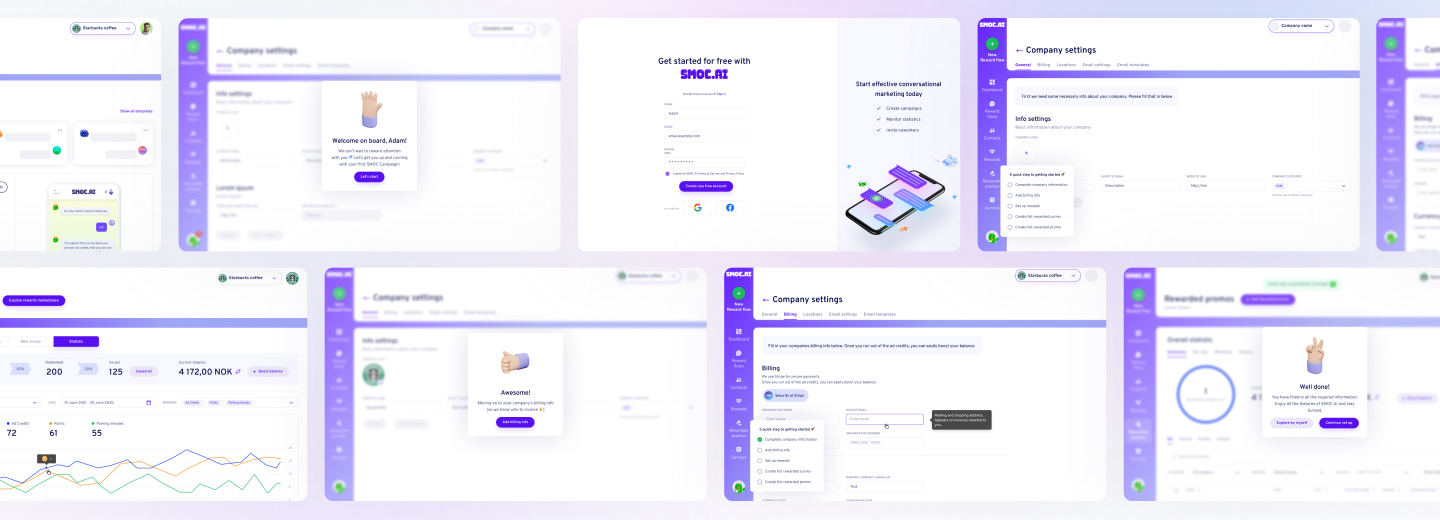
Scaling from Prototype into a User-Friendly and Conversational Marketing Platform
Building an MVP that survives real bereavement conditions
A deathtech MVP is not a landing page plus a form. It is a product that works when people are stressed, grieving, and short on time, across devices, languages, and family dynamics.
One sentence that guides good scope decisions: your MVP should reduce cognitive load, not add options.
That means the highest ROI features are often unglamorous: pre-filled templates, clear document requirements, progress visibility, and plain-language prompts. It also means your support design is part of product, including escalation, response windows, and handoffs.
From a delivery standpoint, the teams that move fastest are the ones that treat discovery, UX, and engineering as one system. You validate not only “will people click buy,” but also “can we complete the case without manual heroics.”
A practical MVP checklist we use in discovery and delivery looks like this:
- Single primary user: Decide who you are building for first (executor, next of kin, funeral director) and optimize their path.
- One critical workflow: Pick the job that creates immediate relief, then measure time saved and completion.
- Minimum viable compliance: Bake in consent, retention logic, and audit trail early so you do not rewrite core flows later.
- Operational fallback: Define when a human steps in, what they see, and how they act without breaking privacy rules.
- Metrics that matter: Track activation, task completion, and time-to-first-value, not just signups.
This is where a product-first development partner can materially change outcomes. Shipping fast matters, but shipping the right workflow, instrumented properly, is what keeps your board, investors, and customers confident after the first cohort.
Architecture patterns: identity, signatures, payments, and integrations
European deathtech products often become integration-heavy earlier than founders expect.
Identity and authority are the heart of it. Depending on your segment, you may need to support national eID schemes, qualified electronic signatures, or document verification flows that satisfy legal partners. The EU’s direction of travel, including the European Digital Identity Wallet and eIDAS updates, will keep raising expectations for secure, standardized identity.
Payments can also be nuanced. Funeral deposits, staged payments, refunds, and chargeback risk all show up quickly in real usage. If you build a marketplace, your payment model must match your legal model: who is merchant of record, who holds funds, what happens when services change, how disputes are handled. This is not only a payments question. It is a compliance and customer trust question.
On the data side, deathtech systems typically need:
- role-based access control with family groups
- encrypted document storage with expiring links
- event-based audit logging
- configurable retention and deletion workflows
- analytics that do not violate privacy commitments
For B2B software, integrations are the unlock: accounting, CRM, booking calendars, cemetery and crematorium scheduling, document generation, and sometimes public registries. Each integration adds value, and each one adds reliability obligations. The right approach is to define an integration roadmap that follows revenue, not curiosity.
What the next few years in Europe are likely to reward
Three forces are shaping the near-term opportunity.
First, standardization of digital identity and signing. As identity rails mature across Europe, products that currently rely on manual checks will be able to streamline authority verification and reduce fraud risk. That directly improves margins because manual review is expensive.
Second, structured data from unstructured documents. Death generates paperwork. Tools that can safely extract data, validate it, and route it to the next step will keep winning. AI can help here, but only when paired with human review design, clear error states, and defensible governance.
Third, partnership-led distribution. Consumer acquisition will keep getting harder and more expensive. Products that integrate into existing ecosystems (employers, insurers, banks, care providers, legal networks) will grow faster with lower CAC and stronger trust transfer.
One sentence worth sitting with: in European deathtech, distribution is often a product feature.
This is also a market where cross-border capability will matter more over time. Families live in multiple countries, assets sit across jurisdictions, and administrative steps vary. Products that can handle country-aware workflows, language localization, and region-specific compliance without becoming brittle will take the lead.

Need Checking What Your Product Market is Able to Offer?
EVNE Developers is a dedicated software development team with a product mindset.
We’ll be happy to help you turn your idea into life and successfully monetize it.
Conclusion
Deathtech teams rarely fail because they cannot write code. They fail because they ship a “feature set” instead of a measurable workflow, or they underestimate compliance and operational reality until late.
EVNE Developers builds web and mobile digital products with a product-first approach: we plan, design, build, and launch with clear business outcomes, rapid MVP delivery, and measurable product metrics. That includes end-to-end discovery, UX, engineering, QA, analytics instrumentation, and the operational tooling that keeps sensitive workflows safe and supportable.
We often get pulled in when one of these situations is true:
- a founder needs an MVP that proves real demand in one country before expanding
- a scale-up needs to harden security, privacy, and audit readiness to win partners
- a team has a struggling build and needs a reset with clear scope, metrics, and delivery cadence
If you are building in deathtech, a useful first step is a short working session to map: your target user, the one workflow that creates immediate relief, the compliance constraints that shape architecture, and the metrics that will prove traction to partners or investors.
If that sounds like what you need, share your concept, current stage, and target countries, and we can respond with a practical build plan, MVP scope, and a delivery timeline that is realistic for Europe’s regulatory and cultural complexity.
Several factors contribute to the growth of the deathtech market in Europe, including an aging population, increased digital literacy, changing cultural attitudes toward death, and a demand for more personalized and sustainable end-of-life solutions. Regulatory changes and the COVID-19 pandemic have also accelerated digital adoption in this sector.
Deathtech solutions include online will-writing platforms, digital memorial services, virtual funeral streaming, grief support apps, eco-friendly burial options, digital estate management tools, and AI-powered legacy planning services.
Technology streamlines administrative processes, increases accessibility to services, enables remote participation in memorials, and offers new ways to remember and honor loved ones. It also empowers individuals to plan ahead and communicate their wishes clearly, reducing stress for families.
Families can benefit from simplified planning, transparent pricing, access to support resources, and the ability to create meaningful digital legacies. Deathtech platforms also help reduce the administrative burden during emotionally challenging times.
About author
Roman Bondarenko is the CEO of EVNE Developers. He is an expert in software development and technological entrepreneurship and has 10+years of experience in digital transformation consulting in Healthcare, FinTech, Supply Chain and Logistics.
Author | CEO EVNE Developers