9
Agile
16+
15
About
HR custom SaaS development process was initiated for a group of maintenance facilities making business in the aviation domain. Being a rather legal requirements-based sphere, the overall approach to the logic of the solution was strictly coordinated with the customers’ representatives. The system was made through the process of SAAS application development from scratch by performing the analysis of the solutions presented on the market for finding business-specified features and distinctive points. The deployment process was adjusted in such a way as to assure the continuous appearance of the releases and a high level of quality at the same time.
Challenge
Creation of a cloud-based system within the market with strict legal requirements to the processes and competitors offering only general and non-suitable solutions for target businesses. The launched system should ensure all-around HR management for enterprise-level companies all around the world. As far as the customer was a small startup at the beginning, a special project management approach was given to the development/ deployment process that resulted in 4-week sprints with continuous deployment and maintenance based on periodic startup consulting services.
Solution
Development of the custom SaaS solution covering primary business goals with setting up of the reliable pipeline of development and deployment process


Roadmap
After estimation, the team performed the complementary analysis of the customer’s business model and their target market, with consideration of the pains of their target audience. This step was separated as core as it made the basis for developed architecture, its scalability and its ability to withstand high load. The analytical approach allowed for avoiding switching from one development methodology to another or even complete rewriting the product. Based on the evaluation results, the team created the roadmap with clear deadlines for MVP deployment and further iterations and updates. As far as it was basically impossible to make calculations on time needed for debugging after launch, the risk-management approach was introduced to make assumptions and maintenance-based estimates. Special consideration was given to business domain standards and requirements that should find their depiction within the system logic and UX. The basic design should help people move from paperwork as it was kind of usual in the domain and introduce the preferences of such a system used in practice.
MVP Dev
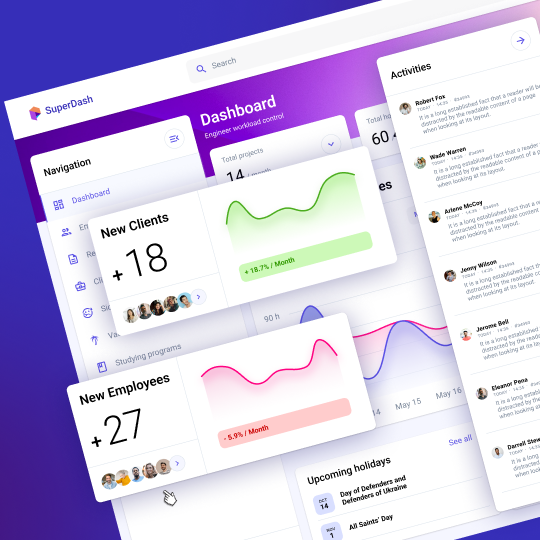
The team moved to the next step of implementation to get the basic product available in the market to test its vital value for the target audience. Based on the performed analysis was formed the technical stack of the product and the team composition. A sufficient level of experience was required for the project to assure the reliable development-market release flow and high quality of the system. The system was based on a modular structure with items that could be adjusted gradually for fast scaling and hosted using cloud technologies for stable work all around the world. The predictable and early delivery process was assured with Agile project management methodology with continuous minor weekly and major monthly iterations. The featured functional scope included: work time tracking, worksheets tracking and management, an employee database with the experience and education items, and reports for management on workload. The analytical section with predictive risk management was left for further iterations. The inner part of the system included the front part, available for users and the admin panel with a wide range of adjustments to suit the facilities in the best way. The sections needed for the company can be edited from the admin panel for each company. One of the requirements of the customer was the introduction of the single-sign-on system. Such a decision was made based on the users’ behaviour who can change their working stations several times a day and require fast and secure access to their personal cabinets. The realisation of this process with OKTA made it seamless making great opportunities for enterprises in terms of accessibility, security and effectiveness. After the final manual and automated testing procedures, the MVP was ready for deployment for early adopters and investors.
CDCI pipeline
As the final repetitive step, the team had to adjust the process of delivery to maintain the strong work of the SaaS solution with continuous evaluation of users’ behaviour and feedback. The received results should find their implementation in further releases and fixes with the direction of constant improvement and scaling. While analytics was gathered by the customer, deep analysis was performed by the Product Owner and Business Analyst to assure that only valuable features find their representation in the product. Such an approach allowed to minimise the funding required for the development. Another requirement from the customer was the preservation of the product quality. As far as the development live cycle stayed basically the same in terms of the Agile process, the proper quality assurance was not a problem for a team even under the pressure of constant and repetitive delivery.