

60%
$1.2M
EU
Logistics
Intro
In an era where geopolitical shifts, evolving trade tariffs, and complex cross-border regulations (such as post-Brexit UK/EU customs frameworks) have made supply chain disruptions a constant baseline, operational agility is no longer optional. Modern freight forwarders and logistics providers across the US, UK, and EU face intense pressure to deliver rapid fulfillment and total supply chain visibility while operating on increasingly compressed margins.
Despite these pressures, many global enterprises remain shackled by fragmented technology stacks. Monolithic legacy ERPs, regional Warehouse Management Systems, and legacy carrier portals often operate in isolated silos. To bridge these gaps, organizations frequently rely on human workers as “digital middleware” while forcing operators to spend thousands of hours manually re-keying shipment data, validating compliance forms, and cross-checking invoices across mismatched systems. This heavy reliance on manual intervention introduces four critical liabilities:
Operational Latency
Slow, batch-driven data entry delays Order-to-Cash cycles and prevents real-time decision-making.
High Error Rates
Manual data entry across multi-jurisdictional customs documents triggers frequent clearance rejections and escalating compliance fines.
Scalability Bottlenecks
Scaling operational volume requires linearly scaling headcount, inflating overhead during peak seasonal surges.
Brittle First-Gen Automation
Traditional, surface-level RPA scripts that rely on UI scraping crumble the moment an external vendor or customs portal updates its interface.
To achieve true operational resilience, enterprise logistics leaders are pivoting from fragmented “quick-fix” scripts toward Hyperautomation. It is a cohesive strategy that combines API-first integrations, self-healing backend workflows, centralized control towers, and human-in-the-loop exception management.
About the client
GlobalDrive Logistics is a £2B revenue supply chain and freight forwarding enterprise headquartered in the UK, with major operational hubs across the US and the EU. They manage over 150,000 cross-border shipments annually, coordinating between manufacturers, customs agencies, and last-mile delivery partners.
Challenge
Despite their scale, GlobalDrive’s backend operations were struggling under the weight of fragmented legacy systems.
Key challenges included:
- Manual Bottlenecks: Customer Service and Operations teams were spending up to 4,000 hours a month manually copying data between their central ERP, regional warehouse management systems (WMS), and government customs portals.
- Compliance Risks: Human error in customs documentation was leading to a 4% rejection rate, resulting in delayed shipments and escalating compliance fines, particularly across post-Brexit UK/EU borders.
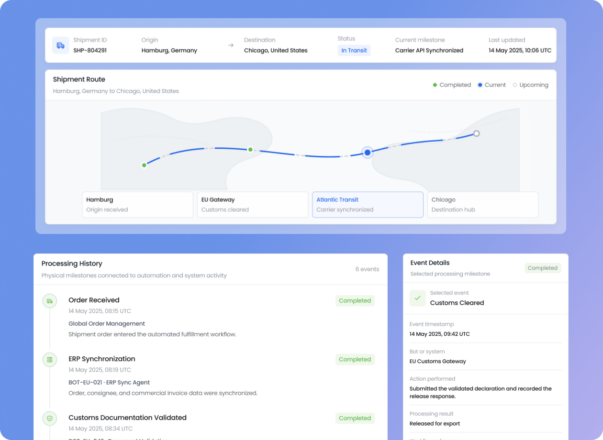
- Lack of Visibility: Because data synchronization relied on manual batch updates at the end of shifts, leadership lacked real-time visibility into the Order-to-Cash cycle, making it impossible to forecast accurately or proactively manage supply chain disruptions.

Solution
Instead of simply deploying “bots” to mimic human clicks, we partnered with GlobalDrive to build a resilient Hyperautomation RPA Ecosystem.
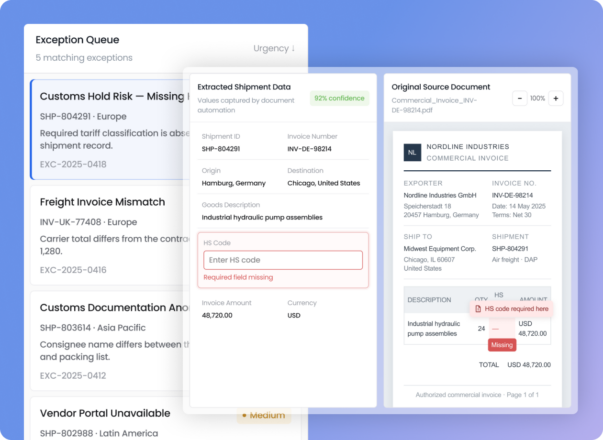
Our business-oriented approach focused on solving the underlying workflow issues first. We designed a “Human-in-the-Loop” architecture: the automated ecosystem handled 100% of standard data entry, cross-system synchronization, and document generation, routing only high-complexity exceptions (like flagged hazardous materials or mismatched invoices) to human operators via a unified digital dashboard.
The Central Control Room: Empowering the Human-in-the-Loop
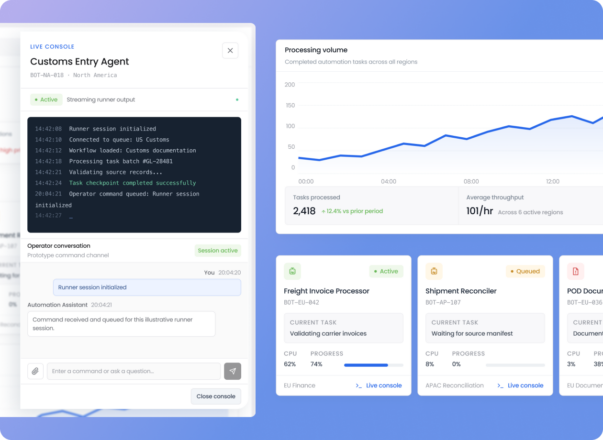
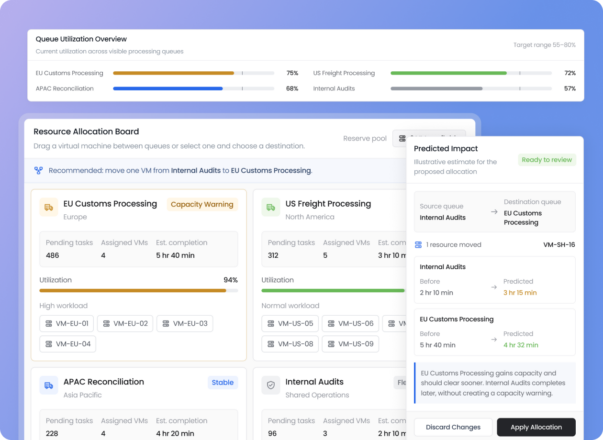
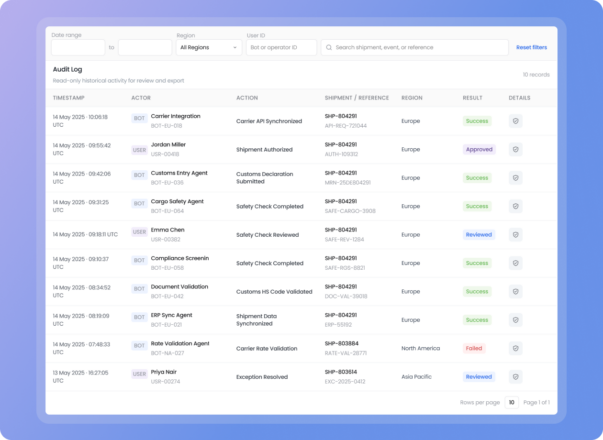
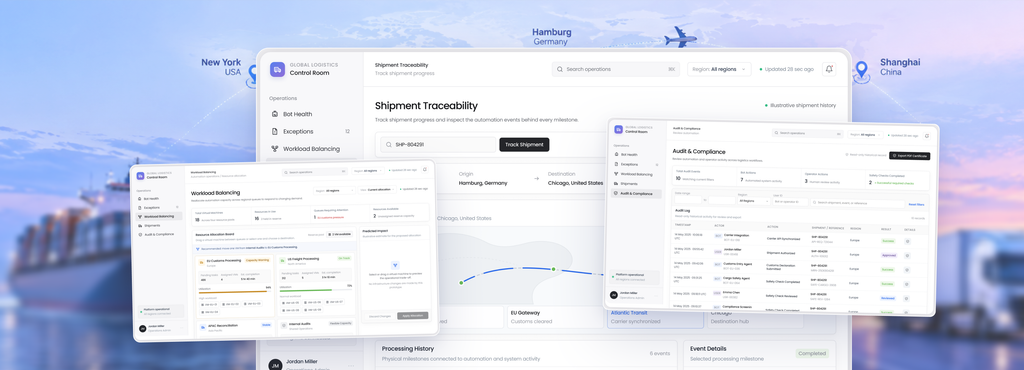
To replace fragmented legacy spreadsheets and give GlobalDrive’s team true oversight, we engineered a unified web portal. This Control Room serves as the operational heart of the RPA ecosystem, centralizing bot management, data visibility, and exception handling into a single pane of glass.
The portal was built around five core functions, each designed with an intuitive UI to bridge the gap between human operators and autonomous systems:
The Process
To ensure we delivered a stable backend that wouldn’t break during routine software updates, we executed a phased, API-first rollout.
Phase 1: Diagnostic Process Mining
Month 1
Rather than guessing where the bottlenecks were, we deployed process mining algorithms to ingest log data from the ERP. This objectively mapped the true supply chain workflow, allowing us to align our automation strategy directly with GlobalDrive’s KPIs (specifically targeting Order-to-Cash velocity).
Phase 2: API-First Architecture Design
Months 2-3
We prioritized robust API integrations between the ERP and internal logistics platforms. UI scraping was strictly relegated to legacy government portals that lacked modern endpoints, ensuring the core automation loop was deeply integrated and stable.
Phase 3: Control Room & Centralized Governance
Month 4
We established a centralized Orchestrator Control Room. This provided GlobalDrive’s IT team with real-time logging, automated load balancing across virtual machines, and a unified dashboard to monitor bot health and queue statuses.
Phase 4: Deployment & Exception Training
Months 5-6
Bots were deployed to handle standard freight processing. Concurrently, we upskilled the operations team to transition from “data entry clerks” to “exception managers,” training them to handle the complex edge cases the RPA system intelligently flagged for review.
Problems Overcome
A project of this scale inevitably faces hurdles. Our team resolved two major challenges during implementation to ensure long-term stability:
Fragile External Portals
During testing, a major European customs portal updated its UI, breaking the initial automation flow.
Solution: We built self-healing mechanisms and dynamic retry logic into the backend. If an external portal timed out or altered a DOM element, the bot automatically queued the task, alerted the Control Room, and dynamically adapted its selector paths without crashing the broader pipeline.
Change Management Friction
Initially, employees feared the bots were there to replace them.
Solution: By positioning the system as a Digital Coworker that only handled repetitive, mundane tasks, and by involving the staff in designing the Human-in-the-Loop exception criteria, we shifted the culture from resistance to active collaboration.
Value Delivered
Operations managers who previously spent their weekends untangling customs data disparities and fighting system errors are now focusing their energy on strategic carrier negotiations and expanding their European market footprint. The pervasive anxiety surrounding post-Brexit compliance audits has been replaced by absolute confidence in the system’s immutable, automated logging.
The leadership emphasized that the new Control Room didn’t just deliver faster dashboards, it delivered fundamental peace of mind. Knowing the backend infrastructure could intelligently self-heal during external portal outages, and gracefully route complex exceptions to human experts, empowered the company to scale its freight volume aggressively. By removing the daily friction of legacy manual processes, the automation ecosystem elevated the entire staff, turning data entry clerks into strategic exception managers and positioning GlobalDrive as a truly agile leader in the modern logistics sector.
By treating hyperautomation as a strategic business initiative rather than just an IT project, the client achieved massive, quantifiable success within 12 months of deployment:
Order Processing Time
Under 4 hours – 60% Reduction
Customs Accuracy
99.8% – Virtually eliminated compliance fines
Labor Allocation
$1.2M Annual Labor Savings – Reassigned to vendor negotiation
Financial ROI
300% First-Year ROI – Break-even at Month 7
EVNE Developers have the skills and experience required to create advanced software tailored to your needs. Hire us to build secure, scalable, and compliant solutions that streamline processes, improve outcomes, and leverage your data effectively.

